Friday, March 18, 2011

A touch of Balkan

A life is a prolonged period of time spent longing for memories or fantasies. Eternity is those short interruptions when desire is directed towards the moment.

At the moment I spend most of this life longing either for Bulgaria, that I left a little more than a year ago, or longing for an idealized Swedish childhood with dizzy contours.
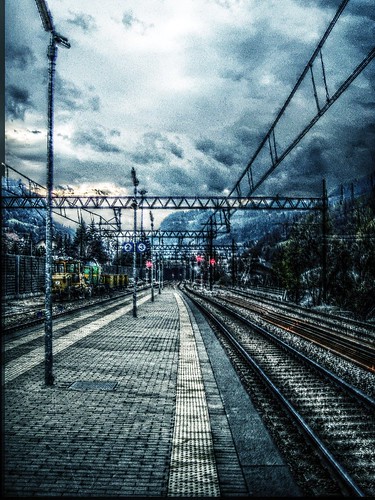
The train will save us from the storm

I spend most of today on trains, and doing this in Sweden 2011 is something that reminds me a lot more about Bulgaria than about Sweden in the late eighties/ early ninties.

The trip from Lund to Gothenburg turned out a lot more convenient than I had feared at one moment. Due to strong winds (more about this later), trains did not run on schedule from Malmö, which affects the entire southern Sweden.

My train was merely 20 minutes late, but trains have been rescheduled we stop only once between Lund and Goteborg, which means that I know no one will come asking for my seat, and I wasn't pennywise to not buy a seat reservation. My brother did, though. His train is on time, but the seat hehad booked turned out to be one for wheel chairs.

There is nothing particularly about a delayed train, or a misunderstanding about a seat reservation. Things like that happens once in a while everywhere. What gives me the feeling of being back at the balkans is that every single time I have been travelling with train in Sweden the last year, something similar has happened.

Trains replaced with buses, criminals on the train and delays. Hours of delays. My brother could add his own experiences to this list, and so could thousands of other Swedish travellers. Not only Swedish, by the way. Last week the German travel bureau Dertours announced that they will stop selling train trips in Sweden, due to the unreliable schedule. Sad news.

It is comparably comfortable to be delayed in Sweden, though. Trains and stations are warm and cosy, and nothing like a Bulgarian train. What gives you the feeling of being in the Balkans is the certainity that some kind of surprise will await you at the station. You count on the train being delayed but go there a long time in advance to be on place when the plan changes. When the train is on time, that is so uncommon, that it also counts as a surprise...

It is a tense feeling in the stomach, a heightened attention about what is happening around you. Is that train over there yours? What is that update on the screen? What did the loudspeaker just say? There can be no relaxation until you get off the train at the right destination. Brace yourself.

Could this be otherwise? Every delay usually have a pretty good explanation. Temperatures were very low this winter, and it did blow hard winds today. But when problems occur this often, there is a systematic error. A train system must be adapted to the weather being where the trains run. And while we are struggling to cope with 20th century weather, we by now know for sure that temeperatures will be more extreme and winds blow harder in a not very distant future. The weather is already more extreme than it was back in my idealised Swedish childhood but there is more to come.

The spectre of climate change poses a formidable challenge to the Swedish train infrastructure. I hope that engineers are already counting on more weather resistant trains, and that polticians are getting ready to pay. For we do need trains, in order to keep our civilisation alive without fossil fuels.

Tuesday, March 15, 2011

On the non-sustainability of nuclear power

Have no fear for atomic energy - cause none of them can stop the time
/Redemption Song by Bob Marley

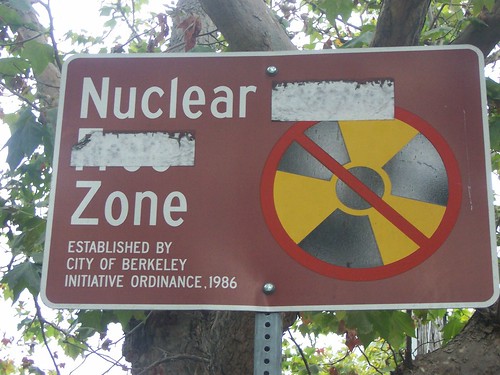
Nuclear Free Zone

As Japan's nuclear crisis is unravelling, the fear of radiation has re-entered the western mind. The Swedish blogosphere is bickering, in the US Obama is defiant, but not triumphant, about the future of nuclear energy in the US. In Germany Angela Merkel gives in to a vocal anti-nuclear opinion that reminds us about the force in political grassroots movements.


I, too, am very frightened about the spectre of a major nuclear disaster, and speechless before the folly of trying to keep nuclear waste safe for 100 000 years. Tomorrow the Swedish nuclear industry will present a plan how to do that... environmental organisations are critical, and argue that the copper containers will corrode after 1000 years. What kind of thousand year's Reich do they imagine that can follow this up until 3011? And what kind of civilisation would be able to keep the danger in memory for 100 000 years? Certainly not homo sapiens - the nuclear industry must hope that some new breed of sapiens appears, and that we manage to transfer vital information about our ecologial footprint to them. Harry Potter is more realistic. Unless these utopias come true, the most likely outcome is that Sweish groundwater will be heavyily polluted and swats of land inhabitable.


But still - have no fear. In spite of all talk about a nuclear renaissance, improved technology and the brilliant idea that nuclear power can replace fossile fuels, nuclear power has no future in a world of expensive oil. Not because it is dangerous, but because it is just as dependent on these fossil fuels as any other industry is.


Consider the mining process - what do you think that the trucks run on? Fossil fuels, of course. Then the very product of the mines have to be transported to powerplants. By sailing boats? Unfortunately not. This trip, as any other, will be fossily fueled.


Once the nuclear fuel reaches the plant, it's consumption emits very little co2, which is about the only positive thing about nucelar power. But for doing so it requires a massive infrastructure, experts travelling in cars, parts coming in trucks and all these things that any other business do. All this things require fossil fuels - and all businesses rely on fossil fuels.


As the price of oil goes up, as it certainly will - the cost of all these transport will be added to the price of nuclear power , and make it a much less attractive kind of energy it is as long as driving trucks is cheap. The cost of building new plants will rise even more since building involves many transports. And that cost is not small even today. Security will likely be less safe when the industry is forced to save money.


There is no future for nucelar power in a peak oil world. Of course it is theoretically possible to run this whole scheme with sailing ships and electric vehicles, but that would require a massive investment in these technologies, investments that are very delayed. It will be very expensive and exposed to the same kind of flaws as fossil fuels - once everyone wants an electric vehicle, we will havea real problem finding metals for batteries.


Nuclear power is a very efficient way to produce energy, but it does not in any way replace fossil fuels. At least not before trucks are electrical. And maybe this is worse than the risk of future groundwater pollution and radiation crises. What so much energy produced so easily does is to make electricity cheaper, which is highly popular among consumers, but also discourages them to save energy. In spite of alleged technical progress, the average Swede consumes more enrgy today than 25 years ago. Maybe the real question about nuclear energy is - how big an obstacle is it to energy saving?


Whatever the answer to that question is, Nuclear power "can not stop the time", as Bob Marley sings. As so many other things, it will become way too expensive when fossil fuels become rare, and few societies wil have the means to keep it running. In stead we will have to look for solutions that do the work with a minimal energy consumption. Small scale, local and smart - those will be the keywords in the future, whether you like it or not.

Friday, March 11, 2011

Creating floods in a world of tsunamis

Unlike most disasters in our time, the tsunami in Japan was neither related to fake liberalism, nor to climate change. Yet it gives us a lot of food for thought, when comntemplating the world we've set to change.
Terrible Tsunami

Earth quakes and tsunamis have existed since before mankind existed. They are a part of this world, which is something we should bear in mind. This world is getting hotter, and when we change the temperature in the atmosphere, we do not add an unknown number of natural disasters to a tabula rasa - we add the catastrophes that we have created to the one's that were there before us.

Reading the news from Japan tonight, one might feel that latter ones are more than enough. Through climate change, we create an awesome potential of an earth quake like this, and floods like in Paktisan simultaneously. Stocks fell in the US on the news form Japan, earing that widespread destrrucion will have ramifications for the world economy. From where will we take the cash to rebuild houses after disasters like that in the future?

Writing from another highly developed country, it is in many wasy easier to relate toa disaster in Japan, than one in Pakistan, simply because the infrastructure in Japan is more like the one I live in. As climatic conditions deteriorate, the disaster we now read about in Al Jazeera, will become the new normal also in the rich world. Japan offers a glimps of what that might look like.

No country could be better prepared to cope with an earthquake, and no country have better economic means to deal with a disaster.  The ease or pain with which Japan raises after this disaster will tell us a lot about our own vulnerability, and hopefully it will be a case study to learn from.

But Japan is not a typical rich country. If our economic thories were valid, Japan should be a very poor country. On both sides of the atlantic politicans have been sacrificing social welfare and democratic rights for one fundamental goal - Economic growth. Japan on the other hand have, forced by circumstances live through an entire decade without growth. Which obviously hasn't ruined the country.

That does not make Japan a perfect example of a sustainable civilisation - the country is struggling to bring down its co2 emissions, but it does prove one thing - that growth and wealth are not the same thing. Japan has no economic growth. But it does have the wealth to deal with a massive earthquake. Which is all that counts in the end.

Tuesday, March 8, 2011

8th of March - the anti corruption day

It is the International Women's Day, and I find myself being an angrier feminst than ever. I am born 1980, and it seems to me that we have already passed the Peak Democracy, sometime around 1995. Society is definitely more traditional, more conservative and more male dominated than it was ten or fifteen years ago.

One example of this is the horrendous rulings by the Swedish Supreme Court. Two weeks ago the court ruled that the men who had bought and sold a 15 years old disabled roma girl in the center of Malmö were free of guilt, and the girl was probably lying. One of several similar cases where men who have been convicted in lower courts for crimes against women are freed in the supreme court.

Utter rubbish, that can only only be explained with one thing - when men commit crime against women, or Swedish against immigrants, judges rule as mildly as possible. Maybe becasue they are all Swedish males themselves.

The Swedish legislation in these matters is strict, and a lot of efforts have been made at combatting this kind of crimes with harder legislation. But the supreme court seems to hold an opinion of their own, that sexual crimes are not really crimes, and in a court the judge's opinion weighs heavier than the politician's.

Which is how it should be in a democracy... at least how it is supposed to work on the paper.  The 20th century showed that political power over the courts lead to tyranny. In the 21th, the independence of courts have turned into a problem. Not only in Sweden - I remember a seminar in Buglaria where environmentalists asked a juridical expert what to do about corruption within the juridical system. The answer was that very little can be done, since politican for good reasons are banned from controlling judges.

When corruption gets into the heart of the juridical system it easily gets very entrenched. The price for that is, as always, paied by those with the weakest voice in society. Like environmentalists, minorities and women. This day is for them all.

Which is why I would like to use this occasion to propagate for a Swedish writere whod edicated her life to the defense of all voiceless people in society - Elin Wägner. She wrote a number of novels, a lot of political writing, and was an activist against war between the world wars. If women like her had power and not only influence, the world would be a better place.

Read about Elin Wägner at Wikipedia
... and on Maladets!