Showing posts with label peak oil. Show all posts

Saturday, December 31, 2011

The world in 2012

The climate in 2012 I am traveling to Bulgaria to celebrate New Year Eve and since I calculated to spend six hours traveling I got myself a copy of The Economist's The World in 2012. 24 hours later I am still traveling and so i could read it twice if I wanted. Which I might. The Economist is one of my favorite English language publications, and I am a big fan of the way the combine insight with a great prose. This time I feel a little let down. The 2011 I lived through was a year not so much of politics as of deep transformations. It was climate change, peak oil and #occupywallstreet. We have yet to see what comes out of that movement, and I did not expect the Economist to sympathize with a movement saying that the interest of 1% is contrary to that of 99%. But I was eager to read some analysis of the return of street politics in the western world. There was none, just a one sentence speculation that US Left wing populism might gt violent in 2012. Did they use a NYPD white shirt officer to edit the paper, or what?
Demonstration on October 17, 1905 by Ilya Repin (adumbration 1906)
Peak Oil is discussed in one article, that actually hopes that OPEC will use its influence to lower oil prices and boost global growth. Are there people at the Economist who actually believe that the current oil prices are inflated by greedy sheiks? During my 2011 countries like Saudi Arabia struggled to meet demand, and will continue to do so in 2012. As for climate change, the treatment of the issue was disheartening. The buzz phrase was sprinkled over the text were appropriate, but in every occasion described as a political choice, e.g. what will it mean for UK politics when the government tries to curb co2 emissions? That is a valid question, of course, but not at all what I expected from the Economist. If someone accepts climate change as a reality, it is also clear that it will have tremendous effect on all kinds of social and economical life. Floods might disrupt industries, or new crops can become profitable. An initiated analysis of how climate change will affect the global economy would be among the most relevant reading right now. How sad that the Economist fails to deliver that. The writers seem to presume that business and politics can exist somehow independently of the physical world they exist in, something that they know very well is not true. But I guess some graphs predictions about how severe weather will affect the US economy would cause furore, and anger the papers' readership. In publishing, you give the people what the people wants.

Friday, June 24, 2011

The S***t hits the fan

Peak Oil has been discussed on-line for quite some time, but while you are reading this, the thing is actually happening. A number of countries dependent on oil-imports headed by the US were so worried about the effect of high pill prices on the economy that they have decided to tap their emergency oil reserve to the market in order to lower prices by political intervention. Prices have, of course, fell, and as could be predicted, another group of countries dependent on oil-exports, OPEC - Saudi Arabia are obviously infuriated. Such a development is almost sure to have geopolitical consequences, but I predict that it will not be the winner of this battle, but the country that first breaks it dependence on oil that will be the next world leader.

Diffraction by oil on water

Tuesday, March 15, 2011

On the non-sustainability of nuclear power

Have no fear for atomic energy - cause none of them can stop the time
/Redemption Song by Bob Marley
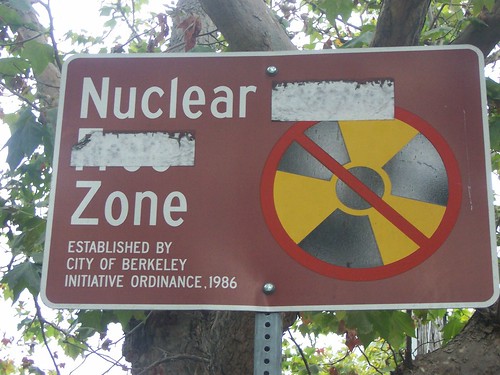
Nuclear Free Zone

As Japan's nuclear crisis is unravelling, the fear of radiation has re-entered the western mind. The Swedish blogosphere is bickering, in the US Obama is defiant, but not triumphant, about the future of nuclear energy in the US. In Germany Angela Merkel gives in to a vocal anti-nuclear opinion that reminds us about the force in political grassroots movements.


I, too, am very frightened about the spectre of a major nuclear disaster, and speechless before the folly of trying to keep nuclear waste safe for 100 000 years. Tomorrow the Swedish nuclear industry will present a plan how to do that... environmental organisations are critical, and argue that the copper containers will corrode after 1000 years. What kind of thousand year's Reich do they imagine that can follow this up until 3011? And what kind of civilisation would be able to keep the danger in memory for 100 000 years? Certainly not homo sapiens - the nuclear industry must hope that some new breed of sapiens appears, and that we manage to transfer vital information about our ecologial footprint to them. Harry Potter is more realistic. Unless these utopias come true, the most likely outcome is that Sweish groundwater will be heavyily polluted and swats of land inhabitable.


But still - have no fear. In spite of all talk about a nuclear renaissance, improved technology and the brilliant idea that nuclear power can replace fossile fuels, nuclear power has no future in a world of expensive oil. Not because it is dangerous, but because it is just as dependent on these fossil fuels as any other industry is.


Consider the mining process - what do you think that the trucks run on? Fossil fuels, of course. Then the very product of the mines have to be transported to powerplants. By sailing boats? Unfortunately not. This trip, as any other, will be fossily fueled.


Once the nuclear fuel reaches the plant, it's consumption emits very little co2, which is about the only positive thing about nucelar power. But for doing so it requires a massive infrastructure, experts travelling in cars, parts coming in trucks and all these things that any other business do. All this things require fossil fuels - and all businesses rely on fossil fuels.


As the price of oil goes up, as it certainly will - the cost of all these transport will be added to the price of nuclear power , and make it a much less attractive kind of energy it is as long as driving trucks is cheap. The cost of building new plants will rise even more since building involves many transports. And that cost is not small even today. Security will likely be less safe when the industry is forced to save money.


There is no future for nucelar power in a peak oil world. Of course it is theoretically possible to run this whole scheme with sailing ships and electric vehicles, but that would require a massive investment in these technologies, investments that are very delayed. It will be very expensive and exposed to the same kind of flaws as fossil fuels - once everyone wants an electric vehicle, we will havea real problem finding metals for batteries.


Nuclear power is a very efficient way to produce energy, but it does not in any way replace fossil fuels. At least not before trucks are electrical. And maybe this is worse than the risk of future groundwater pollution and radiation crises. What so much energy produced so easily does is to make electricity cheaper, which is highly popular among consumers, but also discourages them to save energy. In spite of alleged technical progress, the average Swede consumes more enrgy today than 25 years ago. Maybe the real question about nuclear energy is - how big an obstacle is it to energy saving?


Whatever the answer to that question is, Nuclear power "can not stop the time", as Bob Marley sings. As so many other things, it will become way too expensive when fossil fuels become rare, and few societies wil have the means to keep it running. In stead we will have to look for solutions that do the work with a minimal energy consumption. Small scale, local and smart - those will be the keywords in the future, whether you like it or not.

Friday, August 7, 2009

Nabucco + South stream = crazy

Geopolitics don't seem to have changed much since Napoleon's days. Human Rights, environmental- or even budget concerns are easily sidestepped for Strategic interests. Expenses for Obama's wars are not included in the US budget, and I am pretty sure the same thing goes for Putin's Russia.

That Russia and the West have conflicting around the Black Sea was evident in last summer's war in Georgia, a place were tensions are said to build up again.

Putin has recently visited Ankara, to socialize with the Turkish politicians, and gather support for the Russian oil pipeline project South Stream, a fact that teases the anti-Russian Romanian press. Putin transforms the Black sea into a Russian-Turkish lake, Cotidianul writes.


The point of South stream, a brain child of the soulmates Putin and Berlusconi, is to avoid Ukraine and Romania, two countries traditionally hostile to Moscow, and leverage traditional partners like Bulgaria and Serbia. Bulgaria has so far turned a blind eye to the geopolitical implications, and happily agreed to South Stream as well as Nabucco , EU's competing project. The new government might not be as pro-russian as the earlier, though.

Nabucco is EU's grand project to break free from Russian gas. Eventually the pipeline will be filled with gas from democracies like Azerbadjan, Turkmenistan, Egypt, possibly Iran, and why not... Russia.


Putin seems to play this game much more skillful than his collegues in Bruxelles. The Turkish govenrment works hard to keep the excitement for EU after years of waiting to get in. When Iceland passes in the fast line one can:

  1. understand that Ankara loses hope
  2. understand that Ankara needs to put some kind of pressure on Bruxelles, to make something happen.

EU has offered less than nothing to Turkey, not even a respectful "no". Contrary to EU Russia has now offered Turkey gas supplies, hard cash in a peak oil scenario.

But at the end of the day ... in a world where we might be out of oil within ten years, what kind of madness is it to build two competing pipelines so close to each other? Two pipelines that go through lots and lots areas that should be protected. In the best case scenario Nabucco frees the EU from dependence on Russian oil, devastates nature around the Black sea, and entrenches the EU's dependence on oil. And with Putin in power, don't expect the best case scenario.


Pics. taken from Wikipedia Commons . Cred to them.


Monday, August 3, 2009

White sugar has never been more expensive FT reports...

... but you remember where you read it first, right :P

If it was only sugar that was getting expensive I guess it would benefit global health. But there is reason to expect a rise in food prices like the one we saw last year. Especially since IEA's warnings of imminent Peak Oil. Beware. Grow your own potatoes. And stop using oil.