
Showing posts with label democracy. Show all posts
Showing posts with label democracy. Show all posts
Wednesday, December 21, 2011
Ni är inte ensamma!
When I first visited Bulgaria, in the fall of 2007, I could not help but notice posters, billboards, buttons everywhere saying "Ne ste sami!" It means "you are not alone", and is probably the first full sentece I learned in Bulgarian. In Swedish it would be, literally "Ni är inte ensamma!", and when I come back to Sweden in January after this winter's Bulgaria trip I hope to see those word written all over town.
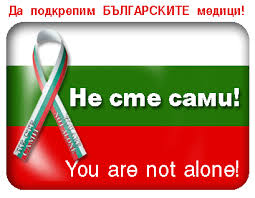 (The Ne ste sami-ribbon)
The slogan was aimed at the five Bulgarian nurses that were sitting on death row in Libya, blamed for contaminating blood with HIV, and killing Libyan children. This was before the Arab spring, and Libya was still a dictatorship where it was easier to blame and jail foreigners than admitting mistakes.
The Arab spring has yet to affect Ethiopia. The state is more suspicious of dissent than ever, maybe scared by the specter of public protest like those in the Mediterranean Arab states. Scores of local foreign journalists have been harassed. Two of them are the Swedes Johan Peterson and Martin Schibbye.
They were earlier today found guilty of supporting terrorists and entering Ethiopia illegally. They have confessed of entering without VISA together with an ethnic militia that has been terror-labeled by the government in Addis Abebba, but maintain that their purpose was solely to investigate the work of the Swedish company Lundin Petroleum in the Ogaden province.
My private opinion is this: Lundin Petroleum is a secretive company with a very bad reputation when it comes to Human Rights. Schibbye and Peterson should be praised, not jailed for trying to bring stories about their work in Ogaden into the light.
Another opinion might be that Schibbye and Peterson were acting foolishly and should be reprimanded and thrown out of Ethiopia but not senteced to jail. This seems to be the official view of our Foreign Minister Carl Bildt (Link in Swedish), who himself worked for Lundin Petroleum when the company's activities in Ogaden were initiated.
A lot of thing could be written about Carl Bildt's dubious role in this drama, but it might suffice to say that the best thing with having him in government is that it keeps him away from Lundin Petroleum where he might do more harm.
A lot could also be written about the terrorism laws that Peterson and Schibbye are sentenced under. Western commentators point out that these laws allow the Ethiopian government to label anyone it doesn't like a terrorist. But it is hardly the first government to do so. It is simply abusing a system of black listing organizations that has been abundantly abused since 9/11.
But right now, the main focus must be to get Peterson and Schibbye home. Sweden needs journalists like them, the world needs to know about Lundin Petroleum and they do need us. They need to know that they are not alone.
The Bulgarian "Ne ste sami" campaign was succesful, and the nurses eventually returned to their families. There is no reason Sweden should not manage to get Peterson and Schibbye free. But it might take a stubborn campaign saying "Ni är inte ensamma!" Let us start it now.
(Foto: Scanpix)
(The Ne ste sami-ribbon)
The slogan was aimed at the five Bulgarian nurses that were sitting on death row in Libya, blamed for contaminating blood with HIV, and killing Libyan children. This was before the Arab spring, and Libya was still a dictatorship where it was easier to blame and jail foreigners than admitting mistakes.
The Arab spring has yet to affect Ethiopia. The state is more suspicious of dissent than ever, maybe scared by the specter of public protest like those in the Mediterranean Arab states. Scores of local foreign journalists have been harassed. Two of them are the Swedes Johan Peterson and Martin Schibbye.
They were earlier today found guilty of supporting terrorists and entering Ethiopia illegally. They have confessed of entering without VISA together with an ethnic militia that has been terror-labeled by the government in Addis Abebba, but maintain that their purpose was solely to investigate the work of the Swedish company Lundin Petroleum in the Ogaden province.
My private opinion is this: Lundin Petroleum is a secretive company with a very bad reputation when it comes to Human Rights. Schibbye and Peterson should be praised, not jailed for trying to bring stories about their work in Ogaden into the light.
Another opinion might be that Schibbye and Peterson were acting foolishly and should be reprimanded and thrown out of Ethiopia but not senteced to jail. This seems to be the official view of our Foreign Minister Carl Bildt (Link in Swedish), who himself worked for Lundin Petroleum when the company's activities in Ogaden were initiated.
A lot of thing could be written about Carl Bildt's dubious role in this drama, but it might suffice to say that the best thing with having him in government is that it keeps him away from Lundin Petroleum where he might do more harm.
A lot could also be written about the terrorism laws that Peterson and Schibbye are sentenced under. Western commentators point out that these laws allow the Ethiopian government to label anyone it doesn't like a terrorist. But it is hardly the first government to do so. It is simply abusing a system of black listing organizations that has been abundantly abused since 9/11.
But right now, the main focus must be to get Peterson and Schibbye home. Sweden needs journalists like them, the world needs to know about Lundin Petroleum and they do need us. They need to know that they are not alone.
The Bulgarian "Ne ste sami" campaign was succesful, and the nurses eventually returned to their families. There is no reason Sweden should not manage to get Peterson and Schibbye free. But it might take a stubborn campaign saying "Ni är inte ensamma!" Let us start it now.
(Foto: Scanpix)


Tuesday, July 27, 2010
Universal suffrage...
I just read in Denyat s Darik, that a deputy from the Bulgarian party GERB, currently in government has suggested that all candidates in public election should take a test of their psychological abilities before they can be elected.
One wonder how Emil Karanikolov understands democracy. Whom would be trusted with the task to test the people? Would this mean that mentally disabled people are not eligble to be elected? Should they have the right to vote? What rights should they have?
In the system that I call democracy every citizen has teh right to vote and to be elected, even though few of them are suitable for office. But the alternative is much worse, as Karanikolov should know. Is it that easy to forget totalitarianism?
One wonder how Emil Karanikolov understands democracy. Whom would be trusted with the task to test the people? Would this mean that mentally disabled people are not eligble to be elected? Should they have the right to vote? What rights should they have?
In the system that I call democracy every citizen has teh right to vote and to be elected, even though few of them are suitable for office. But the alternative is much worse, as Karanikolov should know. Is it that easy to forget totalitarianism?
Wednesday, August 12, 2009
The Swedish Radio and Belarus
Sveriges Radio - the Swedish public broadcasting company has decided to close its sendings in Belarussian. These sendings were a kind of "Radio Free Europe" in the dicactorship Belarus . The Swedish students' group Liberala Studenter have launched an online petition, askin Sveriges Radio to keep the broadcast as a way to support democracy work in Belarus. I was made aware of the topic from posting on the Central europe mailing list. Since it is a public mailing list I take the freedom that publish the entire letter from Sławomir Wójcik here.
Posted by: "Sławomir Wójcik" swojcik@pk.org.pl slawek.wojcik
Sat Aug 8, 2009 3:45 am (PDT)
Protest against Swedish Radio International - who are closing down the
belarusian radioprogramme which had listeners in Belarus (in
belarusian) and promoted the democratic society. The chief of SRI
Ingemar Löfgren says "democracy projects is not our job" - but the
thing is - Swedish Radio is Public Servise and it SHOULD promote
democracy aswell. Please help us support this protest and sign this
petition!
In swedish: Namninsamling startad - protest mot Sveriges Radios
nedläggning av de vitryska sändningarna. Skriv under du med och stöd
demokratirörelsen i Belarus!
http://www.namninsamling.com/InfoBelarus
Press: "Skriv på listan" (=sign the list) down in the corner, then
sign your first name in "förnamn", second name in "efternamn", your
e-mailadress in "epostadress" (it will not be shown on the list, its
just to confirm the signing in a confirmation email) and in "postort"
you write your city. Then press "Spara" (=save).
Thank you!
PLEASE, FORWARD THIS MESSAGE TO ALL, WHOM IT MAY CONCERN!
There are, of course many reasons to keep these broadcasts. Sweden has direct historical, ecological and social ties to the Baltic region incuding Russia and Belarus, and a great reponsibility to work for improved human rights in the region. The fact that Lukajsenko, the dictator of Belarus have showed an increased interest in Europe, should not be an excuse for be more forgiving towards crimes against human rights.
Except for historical and social ties, the Swedish and Polish governments have launched the EU's so called Eastern partnership, a program that was covered in this weekend's Kapital ( #31 page 25). Unfortunately it doesn't seem very clear what the EU wants to offer these countries... certainly not a quick membership, or abolishment of visa regimes. Russia on the other hand, can offer cheap gas and visa-free traveling, at the expense of human rights.
If the EU wants to play hardballs againts Russia, vagueness is unforgivable. And EU showed nothing but indecisiveness towards the violence in Moldova in April. Moreover, as Kapital points out - how can you formulate one coherent policy for countries as disparate as democratical, chaotical Ukraine, authoritarian pro-russian Belarus, a little less authoritarian pro-western Georgia and discretely authoritarian, slighlty democratic and chaotic moldova?
The countries themselves are deeply split on the issue, and in no country, except for Moldova, Kapital writes, is there a strong majority for closer ties to the EU. Kapital adds an interesting graph, showing that in Moldova 80% are for closer ties with the EU and 60% for closer ties with Russia. 140% of all Moldovans are confused I guess...
Maybe Kapital's mistaken graph is closer to ones they got right. Identities are complex, and closer economical ties to the EU and human rights should not necessary exclude a strong cultural affinity with Russia in these countries.
The EU should also ask itself - is Europe ready to redefine itself and regard Moldova, Azerbadjan and Ukraine as parts of Europe - as European as Bretagne or The Rhein valley. If it's not, what could it actually promise?
Tuesday, July 21, 2009
Musing about green Bulgaria
The American Radio Show Living on the Earth has published a nice piece about Zelenite. It is available both as text and as streamed audio :)
The MP3 is also a free download.
From For the nature I also got to know that a new Wind-power park is planned in Bulgaria, which of course is a good thing. We were in the mountains in the weekend, and it was truly a sign of hope to see tow wind-generators on mountain tops.
On the other hand, I am increasingly sceptical towards ´this kind of huge project in general. It will cost 80 Mn Euro, and involve 20 generators. Big investments mean centralised governance and conentration of power.
As the text on Living on the Earth points out, democracy and environmentalism goes together. I think as much as possible of the new clean energy projects should be "outsourced" to private or local initiatives. Sun cells on roof tops, powering up nothing more than the house, is acutally a much better idea I think. At least as an ideal, of course bigger investements might be needed also.

The MP3 is also a free download.
From For the nature I also got to know that a new Wind-power park is planned in Bulgaria, which of course is a good thing. We were in the mountains in the weekend, and it was truly a sign of hope to see tow wind-generators on mountain tops.
On the other hand, I am increasingly sceptical towards ´this kind of huge project in general. It will cost 80 Mn Euro, and involve 20 generators. Big investments mean centralised governance and conentration of power.
As the text on Living on the Earth points out, democracy and environmentalism goes together. I think as much as possible of the new clean energy projects should be "outsourced" to private or local initiatives. Sun cells on roof tops, powering up nothing more than the house, is acutally a much better idea I think. At least as an ideal, of course bigger investements might be needed also.
Wednesday, May 27, 2009
Inconvenient thoughts
Thanks to my better half Annie, I encountered one more excellent example of Bulgarian social blogging - Neyjoten blog (Inconvenient blog)
In a post called "Why I will not vote for Bogo and Zelenite in the European elections", the blogger Svetla Encheva make some very important points.
Svetla is a personal friend of Bogo, Bogomil Shopov that I have often referred to myself. Bogo is now a candidate for Zelenite in the elections to the European Parliament.
The reason for Svetla to object is not that she can't agree with Bogo. On the contrary, she does agree with Bogo and Zelenite, and thank them for a number of things. Bogo has for example been one of the leading characters in the struggle for internet freedom in Bulgaria, that I have reported on before on Maladets!. But as Svetla says "I would rather see Bogo as a citizen than as a politician". This is a profound truth about democracy. A democracy needs active citizens outside the parliament to work. The most active citizen is not necessary the best politician.
The other reason, that Svetla discusses into lenght, is that Bogo is on the list of Zelenite, and she can't support them. For the following reasons:
Zelenite is, and should remain a social movement, not political party. In deed, as Svetla highlights, one thing that makes Zelenite attractive to many young voters is the fact that they are generally not regarded as politicians. The difference between social movements and parties, according to Svetla, is that the former defend the interest of smaller groups than the latter.
A party also verbalizes the interest of a group, but much bigger. For example it's difficult to generate support for a party for elderly, whereas groups defending the rights of retired are normal, and in deed necessary in society.
When Zelenite goes to elections, it does it as a competitor to the blue coalition, and since their political demands are close, they will generally compete for the same voters in stead of uniting them in a strong alternative.
There is no chance that Zelenite actually will make it to the European parliament. In polls Zelenite is not an alternative, but the alternative "other" usually gets between 1 and 2 %.
This is my summary of Svetla's text. The relevance is proven by the massive interest - the post, posted at 5th of May, today two weeks later had more than 67 long comments.
First of all - I believe that Svetla is wrong. There is a real chance for anything to happen, when 25% of the electorate claim that they will not vote or do no know. I would not be overly surprised if Zelenite and the blue coalition find each other before the elections eithe.
The critique she words against Zelenite I have heard before about the green party in Sweden, and I think this is the critique that every new party will face. All parties grow out of social movements. For sure they will have to evolve into something else later. Some do, some don't. But I can not see any reason why Zelenite would not.
But... Svetle is also right. The difference between a social movement and a political party is in real and vital. Zelenite must choose what to be, and if they decide to be a political party, Bulgaria definitely needs a social movement that can take their place. As a political party they will have to make compromises. But someone must be free to say the truth no matter of the political implications. To make a concrete exampe - the party Zelenite might have to prioritize which Bulgarian national park is the most important to save. A non-governmnental environmental organisation should not and must not do such choices.
As a party they will also have to choose their allies. For now the relationship between Zelenite and the blue coalition is rather unclear. There is a facebook group arguing for Zelenite to join the coalition, and it is difficult to imagine any other partners in Bulgarian politics. But a cooperation should either be more substantial than a Facebook group, or fair competition.
Thanks Svetle, for a thought provoking text! :)
In a post called "Why I will not vote for Bogo and Zelenite in the European elections", the blogger Svetla Encheva make some very important points.
Svetla is a personal friend of Bogo, Bogomil Shopov that I have often referred to myself. Bogo is now a candidate for Zelenite in the elections to the European Parliament.
The reason for Svetla to object is not that she can't agree with Bogo. On the contrary, she does agree with Bogo and Zelenite, and thank them for a number of things. Bogo has for example been one of the leading characters in the struggle for internet freedom in Bulgaria, that I have reported on before on Maladets!. But as Svetla says "I would rather see Bogo as a citizen than as a politician". This is a profound truth about democracy. A democracy needs active citizens outside the parliament to work. The most active citizen is not necessary the best politician.
The other reason, that Svetla discusses into lenght, is that Bogo is on the list of Zelenite, and she can't support them. For the following reasons:
Zelenite is, and should remain a social movement, not political party. In deed, as Svetla highlights, one thing that makes Zelenite attractive to many young voters is the fact that they are generally not regarded as politicians. The difference between social movements and parties, according to Svetla, is that the former defend the interest of smaller groups than the latter.
A party also verbalizes the interest of a group, but much bigger. For example it's difficult to generate support for a party for elderly, whereas groups defending the rights of retired are normal, and in deed necessary in society.
When Zelenite goes to elections, it does it as a competitor to the blue coalition, and since their political demands are close, they will generally compete for the same voters in stead of uniting them in a strong alternative.
There is no chance that Zelenite actually will make it to the European parliament. In polls Zelenite is not an alternative, but the alternative "other" usually gets between 1 and 2 %.
This is my summary of Svetla's text. The relevance is proven by the massive interest - the post, posted at 5th of May, today two weeks later had more than 67 long comments.
First of all - I believe that Svetla is wrong. There is a real chance for anything to happen, when 25% of the electorate claim that they will not vote or do no know. I would not be overly surprised if Zelenite and the blue coalition find each other before the elections eithe.
The critique she words against Zelenite I have heard before about the green party in Sweden, and I think this is the critique that every new party will face. All parties grow out of social movements. For sure they will have to evolve into something else later. Some do, some don't. But I can not see any reason why Zelenite would not.
But... Svetle is also right. The difference between a social movement and a political party is in real and vital. Zelenite must choose what to be, and if they decide to be a political party, Bulgaria definitely needs a social movement that can take their place. As a political party they will have to make compromises. But someone must be free to say the truth no matter of the political implications. To make a concrete exampe - the party Zelenite might have to prioritize which Bulgarian national park is the most important to save. A non-governmnental environmental organisation should not and must not do such choices.
As a party they will also have to choose their allies. For now the relationship between Zelenite and the blue coalition is rather unclear. There is a facebook group arguing for Zelenite to join the coalition, and it is difficult to imagine any other partners in Bulgarian politics. But a cooperation should either be more substantial than a Facebook group, or fair competition.
Thanks Svetle, for a thought provoking text! :)
Tuesday, May 19, 2009
Democracy is coming...
Democracy is a strange thing, in deed. Svetla Dimitrova, head of the election authority ЦИКЕП (read TsIKEP), have written a letter to the Parliament, expressing her discontent with a statement from the parliament dating to the 13th of April.
The parliament was not pleased with ЦИКЕП's proposal to raise the barrier for coalitions to 8 %, and as I understand this is what this is about.
The parliament which is increasingly defiant since the third government party, the conservatives, tend to go against their coalition partners in the parliament, and rather vote with the parties in the blue coalition.
With an 8% barrier, the blue coalition would risk ending up outside the parliament. According to the last polls* I've seen the blue coalition have around 6%. Most analyst's sees this proposal as a try from the government to unduly use their legislative power agianst the opposition.
ЦИКЕП's decision was eventually faulted by the administrative court, which is the highest instance in this case.
One could quite easily see a pattern here: The government parties and certain authorities vs. the parliament, the local authorities in Sofia and the administrative court. the pattern i strinkingly similar to the situation in Republic of Moldova, but there the parliament is under control by the communist government.
For sure there are also business interests tied to the government, I would guess that there are interests tied to the opposition as well. The economedia group, which published the high class newspapers capital and Dnevnik, are very close to the blue alliance opposition.
Many bulgarians engaging in the politics expect some kind of silent revolution from the elections, by voting in new voices in the parliament. The defiant parliament is already now appearing as somehow less corrupted than the institutional establishment.
Now, the point of Svetla Dimitrova's letter is that ЦИКЕП is the responsible authority in this case, and that it is not the parlimentary majority's role to mix up in her work... this is a point that can be argued I think.
The Bulgarian constitution prescribes a very high degree of independence for different institutions, much higher than in Sweden for example. Much critique has ben aimed at the juridical system, but in fact the Bulgarian politicians have very small power to change anything, since they are banned form interfering with the courts.
In this case one democratic principle - the power comes from the elected parliament is ocunteracted by another principle, fundamental to liberal democracy - the independence of courts and other instutions. Democracy is a complex thing. In deed.
The parliament was not pleased with ЦИКЕП's proposal to raise the barrier for coalitions to 8 %, and as I understand this is what this is about.
The parliament which is increasingly defiant since the third government party, the conservatives, tend to go against their coalition partners in the parliament, and rather vote with the parties in the blue coalition.
With an 8% barrier, the blue coalition would risk ending up outside the parliament. According to the last polls* I've seen the blue coalition have around 6%. Most analyst's sees this proposal as a try from the government to unduly use their legislative power agianst the opposition.
ЦИКЕП's decision was eventually faulted by the administrative court, which is the highest instance in this case.
One could quite easily see a pattern here: The government parties and certain authorities vs. the parliament, the local authorities in Sofia and the administrative court. the pattern i strinkingly similar to the situation in Republic of Moldova, but there the parliament is under control by the communist government.
For sure there are also business interests tied to the government, I would guess that there are interests tied to the opposition as well. The economedia group, which published the high class newspapers capital and Dnevnik, are very close to the blue alliance opposition.
Many bulgarians engaging in the politics expect some kind of silent revolution from the elections, by voting in new voices in the parliament. The defiant parliament is already now appearing as somehow less corrupted than the institutional establishment.
Now, the point of Svetla Dimitrova's letter is that ЦИКЕП is the responsible authority in this case, and that it is not the parlimentary majority's role to mix up in her work... this is a point that can be argued I think.
The Bulgarian constitution prescribes a very high degree of independence for different institutions, much higher than in Sweden for example. Much critique has ben aimed at the juridical system, but in fact the Bulgarian politicians have very small power to change anything, since they are banned form interfering with the courts.
In this case one democratic principle - the power comes from the elected parliament is ocunteracted by another principle, fundamental to liberal democracy - the independence of courts and other instutions. Democracy is a complex thing. In deed.
Monday, May 18, 2009
Think globally - act locally
Democracy is a strange thing, much like love. On the one hand it is about putting global interests, of society, of the planet ahead of your own. On the other hand it is about expressing your own opinion, and defy central ruling.
I believe actually, that there is a kind of contradiction - the bigger the society, the more despotic central ruling will be, which is why the concept of a democratic Europe is so much more difficult than a democratic Sweden or a democratic Bulgaria.
The citizens in Pomorie have used their democratic rights, and voted about an oil pipeline that was projected to go through their county. The answer was a huge NO! , whith 98,97 % of 14.900 votes against the proposition, Dnes reports.
As happy as the enviromentalists might be about the outcome, numbers like these are usually associated with "free elections" in communist states, so they don't speak well about the local democracy to me. I sort of pity the 153,47 guys who voted yes. I'm from the countryside, so I know that everyone will know who theya re, and let them know...
That said, I would have voted no myself.
Nonetheless, more decisions taken locally is the only way to counteract expolitation of the nature. And it would greatly enhance the Bulgarian, and European democracy.
In Varna, Zelenite have held discussions with local citizens on the topic "The citizen and the power - how can we influence the movement of society and the politics" (That is sort of a litteral translation.) See the pictures here.
BlueLink.net have launched a campaign for internet freedoms. Bluenet usually does not campaign, but provide internet resources for NGO's, but since they feel that their work is threatened by legislation, they have chosen to take a stand.
On their webpage they explain why in an english post. It gives a nice background to civil movements in Bulgaria, points out the pivotal role of the Internet in the new generation of protest movements that are the topic of this blog, and gives quite an optimistic view of this generation.
Read the text, and in case Maladets! is your houshold newssource for Bulgarian NGO's, I suggest that you update with an rssfeed with BluLink's news in English.
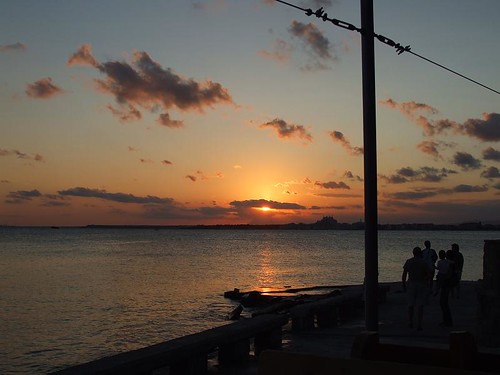
Sunset over Pomorie. Picture taken by NIKO. Taken from creativecommons.org
I believe actually, that there is a kind of contradiction - the bigger the society, the more despotic central ruling will be, which is why the concept of a democratic Europe is so much more difficult than a democratic Sweden or a democratic Bulgaria.
The citizens in Pomorie have used their democratic rights, and voted about an oil pipeline that was projected to go through their county. The answer was a huge NO! , whith 98,97 % of 14.900 votes against the proposition, Dnes reports.
As happy as the enviromentalists might be about the outcome, numbers like these are usually associated with "free elections" in communist states, so they don't speak well about the local democracy to me. I sort of pity the 153,47 guys who voted yes. I'm from the countryside, so I know that everyone will know who theya re, and let them know...
That said, I would have voted no myself.
Nonetheless, more decisions taken locally is the only way to counteract expolitation of the nature. And it would greatly enhance the Bulgarian, and European democracy.
In Varna, Zelenite have held discussions with local citizens on the topic "The citizen and the power - how can we influence the movement of society and the politics" (That is sort of a litteral translation.) See the pictures here.
BlueLink.net have launched a campaign for internet freedoms. Bluenet usually does not campaign, but provide internet resources for NGO's, but since they feel that their work is threatened by legislation, they have chosen to take a stand.
On their webpage they explain why in an english post. It gives a nice background to civil movements in Bulgaria, points out the pivotal role of the Internet in the new generation of protest movements that are the topic of this blog, and gives quite an optimistic view of this generation.
Read the text, and in case Maladets! is your houshold newssource for Bulgarian NGO's, I suggest that you update with an rssfeed with BluLink's news in English.
Sunset over Pomorie. Picture taken by NIKO. Taken from creativecommons.org
Friday, February 20, 2009
There are no shortcuts
Yesterday evening I visited the discusion meeting about the foundations of Bulgarian democracy, arranged by For the nature.
Ruja Smilova, lecturer at Sofiskij Universitet, held a very nice presentation, quickly going through the theoretical underpinnings as well as the problems of finding a blanace between freedom, poular influence and efficient leadership.
Among 30 people attenden, I would guess that for most of them this was not the first meeting with For The Nature, and in a relaxed and open atmosphere they asked questions during and after Smilova's session.
At the end the discussion got more intense, when Smilova had to underlina, that there is no way for citizens to execute complete control over the polticians, except for in elections. Democracy works slowly, and control is executed through knowing what the politicians discuss, and making them repsonsible for it in elections.
As a good example the "Communist Monarchy" Nowray was mentioned ;)
Ruja Smilova, lecturer at Sofiskij Universitet, held a very nice presentation, quickly going through the theoretical underpinnings as well as the problems of finding a blanace between freedom, poular influence and efficient leadership.
Among 30 people attenden, I would guess that for most of them this was not the first meeting with For The Nature, and in a relaxed and open atmosphere they asked questions during and after Smilova's session.
At the end the discussion got more intense, when Smilova had to underlina, that there is no way for citizens to execute complete control over the polticians, except for in elections. Democracy works slowly, and control is executed through knowing what the politicians discuss, and making them repsonsible for it in elections.
As a good example the "Communist Monarchy" Nowray was mentioned ;)
Subscribe to:
Posts (Atom)