
Showing posts with label nuclear power. Show all posts
Showing posts with label nuclear power. Show all posts
Friday, June 24, 2011
The S***t hits the fan
Peak Oil has been discussed on-line for quite some time, but while you are reading this, the thing is actually happening. A number of countries dependent on oil-imports headed by the US were so worried about the effect of high pill prices on the economy that they have decided to tap their emergency oil reserve to the market in order to lower prices by political intervention. Prices have, of course, fell, and as could be predicted, another group of countries dependent on oil-exports, OPEC - Saudi Arabia are obviously infuriated. Such a development is almost sure to have geopolitical consequences, but I predict that it will not be the winner of this battle, but the country that first breaks it dependence on oil that will be the next world leader.


Monday, May 30, 2011
Let Germany save us all
As it happens in democracies, events in the real world affects German politics. After being severly punished in the state elections, Merkel's liberal right governement changed its mind on nuclear power, and decided to honour the previous government's promise to close all German reactors by 2022.

It is easy to hold strong opinions about nuclear power. In spite of the fact that influential green thinkers such as James Hansen and James Lovelock both advocate nuclear power as the best/only way to maintain civilisation without fossil fuels. True as they might be, what Lovelock and Hansen are talking about is the so called fourth generation of nuclear power. These plants theoretically solve a host of the problems today's plants create. Like the waste issue - in stead of building an enrourmous pile of potentially lethal waste, these plants promise to reuse the waste as fuel, until it is not dangerous any more. Which sounds great if it works. We might have no choice but to try.
The facilities that are to be closed down in Germany are nothing like this though. They are old and problem torn. Any one who believes in nucelar power should be glad to see them closed. The industry, however seems more eager to run them as long as they are profitable before building next generation plants, which is the core of the nuclear problem. Nuclear power could maybe be safe in the hands of scientists like Lovelock and Hansen, but any CEO will treat it as just another souce of large and safe income which makes him relunctant to renew it.
The reactions in Sweden, and elsewhere in Europe, to the German U-turn is shock and fear. The major newssource Dagens Nyheter claims that the price of electricity will double if the decision is carried through. Interstingly, most people interviewed in the article does not think so, but DN chose that headline. For some reason, that is what they want readers to believe.
Let us for a moment presume that it is true. Prices on electricity will double. Everyone agrees that we need to save energy - wouldn't a drastic price hike be the best way to create energy prudence? Wouldn't it drastically increase the profitability of renewable energy?
For sure it would, and the way things look right now it would be a blessing. The Swedish energy authority forecast Sweden's energy useage to keep growing until 2030. If that happens, what chances do we have to lower co2 emissions? None. Any positive development would require a shock therapy. If the decision in Germany doubles prices in Sweden - we ought to thank he Germans for saving our future. Unfortunately, it is so much easier to whine about higher prices, than to realize what problems low prices create.
IN the real world it is unlikely that the German decision will have so drastic consequenses, and it is still far from fait accompli . Merkel's decision must first be approved in the parliament, where it will come under fierce critizism from the industry and politicians. It will be intersting to see who comes out as the winner in the end - Europe's strongest civil society or an infamous industry.
I

It is easy to hold strong opinions about nuclear power. In spite of the fact that influential green thinkers such as James Hansen and James Lovelock both advocate nuclear power as the best/only way to maintain civilisation without fossil fuels. True as they might be, what Lovelock and Hansen are talking about is the so called fourth generation of nuclear power. These plants theoretically solve a host of the problems today's plants create. Like the waste issue - in stead of building an enrourmous pile of potentially lethal waste, these plants promise to reuse the waste as fuel, until it is not dangerous any more. Which sounds great if it works. We might have no choice but to try.
The facilities that are to be closed down in Germany are nothing like this though. They are old and problem torn. Any one who believes in nucelar power should be glad to see them closed. The industry, however seems more eager to run them as long as they are profitable before building next generation plants, which is the core of the nuclear problem. Nuclear power could maybe be safe in the hands of scientists like Lovelock and Hansen, but any CEO will treat it as just another souce of large and safe income which makes him relunctant to renew it.
The reactions in Sweden, and elsewhere in Europe, to the German U-turn is shock and fear. The major newssource Dagens Nyheter claims that the price of electricity will double if the decision is carried through. Interstingly, most people interviewed in the article does not think so, but DN chose that headline. For some reason, that is what they want readers to believe.
Let us for a moment presume that it is true. Prices on electricity will double. Everyone agrees that we need to save energy - wouldn't a drastic price hike be the best way to create energy prudence? Wouldn't it drastically increase the profitability of renewable energy?
For sure it would, and the way things look right now it would be a blessing. The Swedish energy authority forecast Sweden's energy useage to keep growing until 2030. If that happens, what chances do we have to lower co2 emissions? None. Any positive development would require a shock therapy. If the decision in Germany doubles prices in Sweden - we ought to thank he Germans for saving our future. Unfortunately, it is so much easier to whine about higher prices, than to realize what problems low prices create.
IN the real world it is unlikely that the German decision will have so drastic consequenses, and it is still far from fait accompli . Merkel's decision must first be approved in the parliament, where it will come under fierce critizism from the industry and politicians. It will be intersting to see who comes out as the winner in the end - Europe's strongest civil society or an infamous industry.
I
Tuesday, March 15, 2011
On the non-sustainability of nuclear power
Have no fear for atomic energy - cause none of them can stop the time
/Redemption Song by Bob Marley
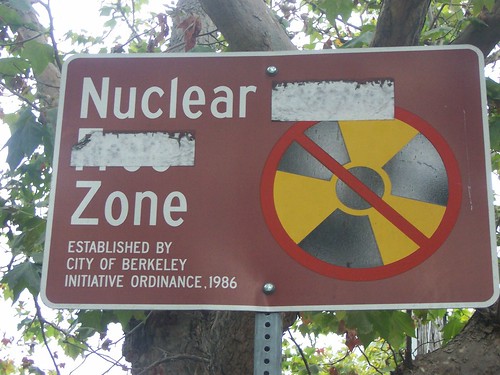
As Japan's nuclear crisis is unravelling, the fear of radiation has re-entered the western mind. The Swedish blogosphere is bickering, in the US Obama is defiant, but not triumphant, about the future of nuclear energy in the US. In Germany Angela Merkel gives in to a vocal anti-nuclear opinion that reminds us about the force in political grassroots movements.
I, too, am very frightened about the spectre of a major nuclear disaster, and speechless before the folly of trying to keep nuclear waste safe for 100 000 years. Tomorrow the Swedish nuclear industry will present a plan how to do that... environmental organisations are critical, and argue that the copper containers will corrode after 1000 years. What kind of thousand year's Reich do they imagine that can follow this up until 3011? And what kind of civilisation would be able to keep the danger in memory for 100 000 years? Certainly not homo sapiens - the nuclear industry must hope that some new breed of sapiens appears, and that we manage to transfer vital information about our ecologial footprint to them. Harry Potter is more realistic. Unless these utopias come true, the most likely outcome is that Sweish groundwater will be heavyily polluted and swats of land inhabitable.
But still - have no fear. In spite of all talk about a nuclear renaissance, improved technology and the brilliant idea that nuclear power can replace fossile fuels, nuclear power has no future in a world of expensive oil. Not because it is dangerous, but because it is just as dependent on these fossil fuels as any other industry is.
Consider the mining process - what do you think that the trucks run on? Fossil fuels, of course. Then the very product of the mines have to be transported to powerplants. By sailing boats? Unfortunately not. This trip, as any other, will be fossily fueled.
Once the nuclear fuel reaches the plant, it's consumption emits very little co2, which is about the only positive thing about nucelar power. But for doing so it requires a massive infrastructure, experts travelling in cars, parts coming in trucks and all these things that any other business do. All this things require fossil fuels - and all businesses rely on fossil fuels.
As the price of oil goes up, as it certainly will - the cost of all these transport will be added to the price of nuclear power , and make it a much less attractive kind of energy it is as long as driving trucks is cheap. The cost of building new plants will rise even more since building involves many transports. And that cost is not small even today. Security will likely be less safe when the industry is forced to save money.
There is no future for nucelar power in a peak oil world. Of course it is theoretically possible to run this whole scheme with sailing ships and electric vehicles, but that would require a massive investment in these technologies, investments that are very delayed. It will be very expensive and exposed to the same kind of flaws as fossil fuels - once everyone wants an electric vehicle, we will havea real problem finding metals for batteries.
Nuclear power is a very efficient way to produce energy, but it does not in any way replace fossil fuels. At least not before trucks are electrical. And maybe this is worse than the risk of future groundwater pollution and radiation crises. What so much energy produced so easily does is to make electricity cheaper, which is highly popular among consumers, but also discourages them to save energy. In spite of alleged technical progress, the average Swede consumes more enrgy today than 25 years ago. Maybe the real question about nuclear energy is - how big an obstacle is it to energy saving?
Whatever the answer to that question is, Nuclear power "can not stop the time", as Bob Marley sings. As so many other things, it will become way too expensive when fossil fuels become rare, and few societies wil have the means to keep it running. In stead we will have to look for solutions that do the work with a minimal energy consumption. Small scale, local and smart - those will be the keywords in the future, whether you like it or not.
Subscribe to:
Posts (Atom)