Showing posts with label European Union. Show all posts

Monday, May 17, 2010

Stockholm and Brussels revisited.

Awkward. Maybe that's the best way to describe Sweden's relationship to the European Union. Last week the former Finnish prime minister Paavo Lippanen vented his spleen on Sweden, that unlike Finland chose to remain outside the euro zone. That is maybe not really fair of him - the Swedes who voted no to the Euro did it becasue they thought joining the euro zone would harm the Swedish economy. Lippanen probably thought that it would do the Finnish economy good, and not only out of his belief in the European project. Lippanen was especially disappointed with his social democratic counterpart in Sweden, Göran Persson.


Be it fair or not, Dagens Nyheter's liberal chronicle writer Michael Wolodarski agrees with Lippanens criticism of the Swedish social democrats. That probably comes easy to Wolodarski, but the writer is worried about the current liberal right government's luke warm attitude towards the euro. Prime minister Reinfeldt, who used to be a staunch euro supporter, has publicly expressed his doubts about the project, and seems happy to keep Sweden out of the current turmoil.


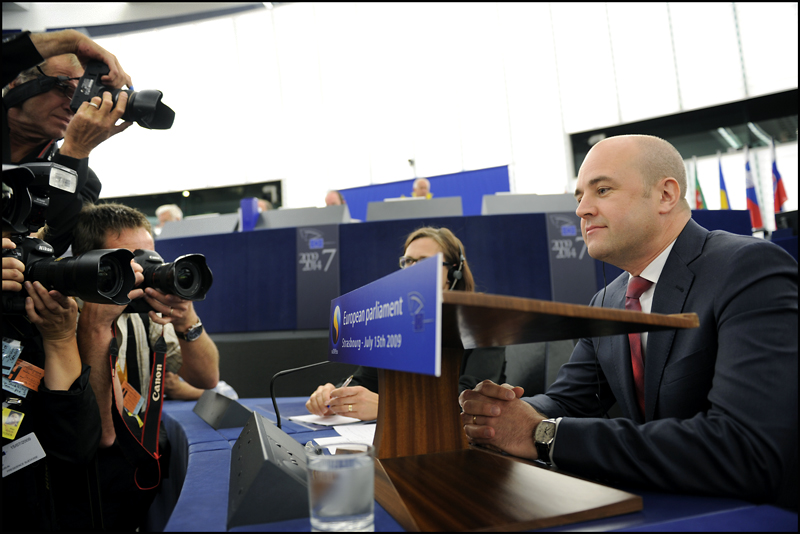
Picture from the European Parliament

For Wolodarski, who is more of a liberal ideologist than a politician this is incomprehensible.

Friday, May 14, 2010

Stockholm vs. Brussels - a new deal?

Greece's close-to-bancruptcy has rattled the EU. The seriousness of the situation is underlined by the magnitude of the answer that came form the EU finance ministers last week. The fantastic sum of 750 bn EUR is supposed to calm the markets, and to show how dedicated European leaders are to save the Euro. Only time will tell if it is enough.

Yesterday the European Commission announced that a whole number countries, among them Sweden and Bulgaria did not meet the requirements to joint the Euro zone. Estonia did meet the criteria, but this looks more like a polite way of saying that the Eurozone has more than enough of its own problems right now. One of this problems is obviously the different economic realities in the different euro zone countries - and each new member state will make the divergence even bigger.


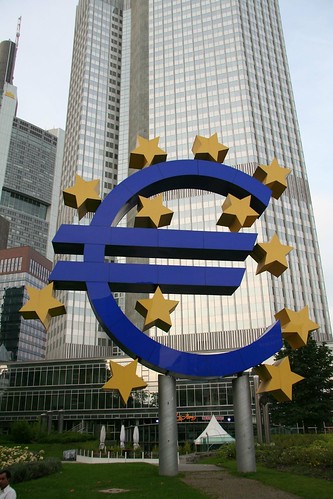
Image by irene

In spite of headlines talking about the collapse of the Euro, both Bulgarian and Swedish politicians have stated that they are looking to join the Eurozone, which seems suidical at a first look.

Wednesday, December 2, 2009

Santa claus is coming, again...


Christmas is coming, this year again. It is a holiday to spend with friends and family, and I and my girlfriend will go spend it in Bulgaria, after 3,5 months of abscence.

There will spend it on the 24/25th of December, the same dates as my own family in Sweden. So do protestants and catholics, and so do the Romanian and the Bulgarian churches. Other orthodox churches, like the Russian and the Serbian, celebrate on the dates from the Iulian calendar - the 6th of January.

In Bulgaria press, priests and other pundits have recently been discussing to move the date of christmas forward to the 6th of january. It seems quite unlikely to happen - just imagine the christmas shopping season beginning two weeks later in one EU-country than in the other's. Wouldn't that be a obstacle to free trade? Moreover, the question can only be decided by the Holy Synod, and last time time it was up or discussion, a big majority was against it.

But when did the date actually change from the 6th of january to the 25th of december? (We might highlight the ethoncentrism here - the 6th of january is oviosly the date the christmas falls on in OUR calendar, not the serbian or russian church's calendar).

The catholic church changed the dates in 1583. This is time when the ottoman empire was at its strongest. The ottomans could be cruel with minorities that they perceived as a threat to the state, but they were convinced liberals in religious matters. To the orthodox churches the catholic efforts of prozelysation was a much worse threat than the sultans' political power, so they did not have any strong reason to change the dates. Quite on the contrary - they had a strong reason to differ from the catholic church, in order to defend their identity. So they stuck with the iulian calendar's date - the 6th of January.

An irrelevant impasse - Sweden didn't change calendar until 1753. Whatever else that signifies, I think it is a hint that our place in Western Europe was not obvious for a very long time.

In today's Moldova, christmas can be a very prolonged holiday. Firs there is the romanian/western christmas at 25th. Where I was living, one of our neighbours belonged to Jehova's Wittnesses so we celebrated already the 24th. Then the party is on until new years eve. There is really no point in starting to work then, because at 6th of January the russian church celebrates christmas, and after a week its own new year. Then, at the end of january, things go back to normal.

With the tangible contradictions between east and west in Moldova, the choice to celebrate christmas on the same date as Western Europe seemed to signify a deeper sense of European identity. This is also what many people said. Those who were actively pro-romanian thought of the russian christmas dates as obsolete, a left over from the Russian imperialism masked as communism. But quite frankly, Moldovans of all denominations usually celebrated both dates.

With this in mind, it seemed all natural to me that Bulgaria, an EU member state with a people very convinced about its European identity, celebrated on the 25th of december. This is also what many commentors say - we are Europeans, let's celebrate like in Europe.

But when did Bulgaria change? Did people celebrate on Russian dates during communism, when Bulgaria was sometimes described as "the 16th soviet republic"? No. First of all - the communist rulers did what they could to make people celebrate new year in stead of christmas. And guess what, in 1948, two years after the communist takeover, the communists aligned the Bulgarian church's calendar, not with the Russian, but with the western catholic.

Those who now ask for a return to the 6th of January say that this decision, taken in 1948 by the highest synod, was taken under political pressure, and therefore is not valid. Political pressure is probably an understatement, but the irony is that reverting this forced decision today, would most likely signalize to most people a return to the communist heritage of choosing Russia over Europe.

History is sometimes a complicated web of ambigious identities. But when you finally sit down at the christmas table all of that seem to disappear.

Source: Dnes.dir.bg
Picture from creative commons, credits to: Darwin Bell
Sunday, September 6, 2009

Social justice II

Traveling in Europe these in these days offers some food for thoughts. About who is European. And if those who are not are equal in the eyes of the law. Except for a failed attempt to smuggle in a cat into Sweden, I and my partner travelled without harrasments, scandals, or very careful checks. I could probably not have travelled with my brothers passport, but I had the feeling that no one ever really checked if this was me. Which is, of course, the point of the European Union, Schengen etc.


Not everyone was so lucky though. A gypsy woman, additionally from an unknown country whose citizens are considered potential criminals and need a visa, was interrogated in a quite humiliating way in front of well dressed and well behaving Europeans by the Hungarian border police in Budapest airport. Of course, Hungarian police is not famous for ethnic tolerance, but how comes this is not a major EU problem?


We rushed towards our gate, where the plane to Coenhage would take off from. There was no need to rush, however, because there was a major scandal, and all of us had to wait. A Swedish speaking man of middle eastern descent, was judged to sick to board the plane. Not such a nice surprise for him of course. I guess it could be seen as an isolated case of bad luck, but who does? Who is surprised that it is a dark skinned man, probably a muslim that gets in trouble? No one. In deed... maybe the reason that Western Europe turns a blind eye to the roma issue in eastern Europe, is that they don't know how to deal with their own minorities.


The poor brown guy didn't enter the plane but the Swedish guy did and that could have been the end of the story. Maybe he really was sick, and in these times of various viruses, It might be necessary to restrict sick people's right to fly. The only problem is that this scene is played up again and again. The actors are the same - policemen or other authorities from the majority population vs. "immigrants" with considerably darker skin and a different religion. In fact - who says that they are not themselves policemen? They might be anything, but in this theatre there is only one role - immigrant.


This weekend we visited some Bulgarians living in Copenhagen. I guess they would have a thing or two to say on this topic as well, but it was all very fine. We travelled there and back in bus. The thing about buses are that they are very cheap, and attract many immigrants, travelling between frinds and families in north European cities, I guess. The difference in terms of ethnicity between a Swedish train and a Swedish bus is big. And one more thing... they always get stopped and checked with narco-dogs on the border. I have travelled many times across the Scandinavian borders, and I never saw a custom control on the train, or on cars. On the bus it happens more than often.


Why is this? I think there might be a good reason behind any one of these cases, but it is anyway difficult not to see a pattern, where certain Europeans are more equal than others. You are much more likely to be checked, or end up in problems if your hair is black than if it is blond. Can Europe afford such an injustice?