Showing posts with label Bulgaria. Show all posts

Wednesday, July 24, 2013

Bulgaria is burning

I have been planning to write something about the anti-governmental protest in Bulgaria for a while - after last night's events I feel I have to get it done.

In February Sofia witnessed massive street protests against the government, initiated by expensive heating bills. The center-right-populist GERB government quickly resigned and called new elections. These elections were carried out on 12th of May. GERB got the largest vote, but was unable to form a government, thus a technocrat government was elected, dominated by BSP (socialist) and DPS (representing the Turkish minority).

When the infamous media mogul (think a teenage Robert Murdoch) Delyan Peevski, with an impressive and well known CV of murky business was appointed head of the State Agency for National Security, Sofia's streets were again filled with protesters, asking for the government to resign. Last night (23/7 2013) protestors surrounded the parliament and prevented MP's from leaving, which lead to a night of tumultuous scenes, 2 injured policemen and 15 injured protesters.

Judging from the TV scenes, it seems that the police were far from controlling the situation, and that most of those hurt were innocent bystanders or doing non-violent resistance, for example sitting down in the way of vehicles. The number of injuries would have been way higher if the crowd had not showed an impressive self-restraint.
Septemvri 1925
The protests had so far been massive, with tens of thousands of people attending, peaceful and innovative - with arty flash mobs, coffee drinking, bike- and marathon protests. They have called for the resignation of the government, amends in the election law and expressed a general disdain for the Bulgarian political class in general, and more specifically the socialists, seen as non-reformed communists, decidedly pro-Russian.

There has also been a strong emotional sentiment. I think many Bulgarians feel offended by the way the politicians did business-as-usual when appointing Peevski, at a time when Bulgarians expected a profound change for the better, and by the arrogant way the government has ignored the protest during the last month.

As a left leaning European it would be tempting to connect this eruption of popular discontent with the anti-austerity protests showing up from time to time in Spain, Greece, Portugal and Italy. (And maybe even Tunisia and Egypt...) That is hardly true. Economic grievances have not been on the agenda in these protests, and when it is it is actually pro-austerity resistance against the government's budget proposal.

On the contrary, a very vocal group among the protesters have been right wing libertarians. This has caused some bad blood and make someone like Petar Volgin, one of the very few public left wing voices in Bulgaria condemn the protests. But it is more than obvious that the belief in Ayn Rand's fairy tale world is not enough to drive so many Bulgarians into the streets for so many days. This is a people that is angry,  not a right wing coup, as some people complain.

Less leaning commentators have connected the protests with those in Brazil and Turkey, and there is probably more to that theory. Just like in these countries, the protests in Bulgaria is dominated by young, well educated, middle class people in Sofia, even if they have a far wider support. They are people who live modern lives in states less modern, who have started to demand a state that is less corrupted and more reliable.

Another all too obvious comparison is with the colour revolutions in Ukraine, Georgia etc. during the 2000's. When I lived in Bulgaria in 2007 i told people about Moldova, and the Bulgarians asked me if Moldova hadn't yet had its colour revolution. Moldova did, and now the Bulgarians find themselves in the streets shouting "maffia!" at redressed communists who enjoy the spoils of private enterprise but are less sanguine about European values, or markets that actually work.

The track record of the colour revolutions is not very inspiring - neither Ukraine, Moldova or Georgia is much closer to Europe or a real democracy now than they were in 2005 or 2000. But it is probably also a miscalculation by Bulgarians to stress the similarities between Bulgarian socialists and Yanukovich in Ukraine. Bulgaria is an EU member, and Russia could never play the role in Bulgaria that it can play in Ukraine.

Moreover, the Bulgarian socialists may be throughout corrupted, but there is hard to see anything totalitarian about Bulgaria. Bulgaria is not facing a state that owns the oligarchs, as Russian dissidents do. They face a state that is owned by private business, which is more like a perverted version of west European politics.

Due to the violence yesterday the parliament is closed today, but tomorrow it will take up work again, and some sort of protests will most likely resume. Hopefully they will continue in the peaceful vein of the first 40 days.

Will they succeed? Yes. No. And yes. I am convinced the government will eventually resign, probably after preparing their comeback with hand outs like economical benefits to the part of the electorate that is rather distanced from the protests in Sofia, that will suffer most from the next right wing government, be it GERB or some of the other parties that are more popular among the protesters.

The political culture in Bulgaria will not be much different in 2015 from what it is now. If the oligarchic model is to be challenged, the economical interests of the oligarch's must be hurt, and to do that would take a more vigilant grass root political environment, running their own parties, their own media. It will take time, but the protesters have so far shown a lot of persistence.

So yes... After these protests, Bulgaria will not be the same, even if the politicians are. Whatever happens after the resignation of the government, many of those that are currently in the streets will feel that there are more steps to be taken. Petar Volgin has lamented the lack of an intellectual left in Bulgaria, but it might just be the birth of it that we are witnessing now. In the streets people come together in a decidedly un-libertarian act of political action. They are fighting for their society, and when the first obstacle - the government, is overcome, they will continue to fight for it.

Tuesday, November 6, 2012

No arson on Vitosha

The Bulgarian police has investigated whether arson was behind last summer's fires on Vitosha Mountain, and found no one guilty, SEGA [Spasi Vitosha] reports.

Incendie Granville 1793
Suspicion about arson have circulated since days after the fires. The fires erupted in an area seldom visited by tourists, so it was unlikely that a visitor would have lit it by mistake. But the police have now gone through material filmed from helicopters, seeing no signs of anyone at all, even though an arsonist would need quite some time to get from the spot.

This is hardly compelling evidence, but it is still worrying. Bulgaria, as the rest of the Balkans did endure an extremely hot summer due to climate change, and if this fire erupted without human interference, more fires is a likely scenario to play out in the years ahead.

In the wake of Hurricane Sandy I would like to add that whereas climatologists are not so certain that global warming causes hurricanes, there is no doubt that global warming will lead to more draught and floods.

Also in Sweden the last summer has been discussed this week in the public radio. It was extremely wet, which made some farmers suffer, while others saw record harvests. Again - it is not proven that climate change leads to more hurricanes, but certain that it will change rain patterns.

I think this illustrate how climate change will be a very different experience in different places. To some Europeans it will mean dangerous events like wildfires and floods, to some it will mean that some places for growing potatoes will have to be abandoned for others.

The second scenario, which is more likely for Sweden is probably a whole lot easier to live with, and would so be if we ate only potatoes. But the true impact on Sweden will come not from extreme events, but from disruptions of global supply chains in other countries.


To round off, I couldn't help but laughing at this commercial, visible next to the article in SEGA.


Santa Claus in a sun chair... the airplane exhausts say "nothing's wrong". Quite a telling picture of what climate change will look like. The irony is not lessened from the fact that the ad is for an oil company - Overgas
 

Tuesday, July 3, 2012

When I am writing this I am aware of three areas struck with wild fires - in the US, in Spain, and in Bulgaria. I suspect there are many more that I do not know about. And for sure, there are many more to come.

Johan Christian Clausen Dahl Waldbrand 1846

Climate change has been hotly debated for several years, and anyone who has read an article about it will know that more, and more intense, wildfires is one out of many predictable effects of a warmer atmosphere. Other predictable effects are fiercer storms, droughts and floods.

The key fact is that warm air holds more vapour than cold air. That means it will rain more seldom, but more intense when the rain falls. Some places are flooded, while others remain dry.

The key insight is that weather has always been potentially extreme. On a certain location at a certain time, there is always a potential for extreme weather. A warmer climate does no bring any new events - it simply changes the likelihood of them to occur.


But given that the world is now somewhere around 0.6 degrees warmer than it was 30 years ago, and given the immense damage caused by events like the wildfires in Colorado, it is very relevant to ask to what extent these events are due to warmer weather.

Scientists and activists who have been saying this for years of course make this connection. And you can find journalists in regional newspapers. But you will search in vain for a discussion of climate change in connection with real world events in major news outlets like CNN or NY Times.

This would make sense if CNN and NY Times rejected the idea that warmer temperatures affect the weather, but, alas, you can find several articles describing the effects of climate change on these sites.

How can an article that predicts that climate change will give more wildfires, not be referred to when wildfires do appear?

It's the politics, stupid. One could easily imagine the loathsome comments to a NY Times article about wildfires that even hinted at climate change. It would be highly controversial.

But if we let such bigotry stand in the way of discussing climate change when it happens, how could we ever manage to deal with it? Well... it is like that. We can't.

Wednesday, July 13, 2011

Sofia Bikes

Before heading south to Plovdiv I've spent a little less than 24 hours in Sofia. It was relentlessly hot, and to a large extent everything was as I remembered it. Lots of shabby houses still standing around, several new glass and steel buildings int he outskirts, and building sites everywhere which gives a sense of a constant work in process.

Besides from the better looking park in front of NDK, two things impressed me, though. One was the boom of small stores/bars/restaurant with a dedicatedly alternative and green image. The second thing was that it seemed everyone has bought a bike since I was last around.

This post is the first on my holiday blog maladets! - freewheeling. Stay updated with it, if you want to read more like this. 


(Picture grabbed from the  Among the Birds blog) (c) 2010 Zona Urbana

There are a lot of cool places to go nowadays for those living in, or staying in Sofia. A bunch of alternative water holes present themselves on this lovely cartooned map of Sofia. A must for anyone who wants to visit the best of Sofia. This kind of places, the common ground between them might be a shared clientèle, and shared values like alternative life style, small scale and environmental thinking. It is vegetarian restaurants, bio-shops, and craft stores producing jewelery form recycled material.

As a Swede, it is not without envy that I watch such places appearing one more and more street corners. In my home town, Lund, the development seems to be the opposite - small stores are rapidly pushed out of market by big retail chains and the shopping malls outside the city. It is curious how the numerous malls in Sofia has not yet managed to destroy this market for small scale commercial activities.

Two reasons are obvious - more and more young Bulgarians have developed a taste for this kind of things, and also some money to pay restaurant bills with. And due to the still rough state of many buildings in central Sofia, rents are still far from what they are in Western Europe, even in a place like Lund, which makes it easier to make money on small businesses. If I was a Sofia politician, I would think a lot about how to improve buildings in the center, without raising rents too much. Too many cities have made their centers tidy but boring. Sofia still has a chance to avoid that.

So for the bikes. When I was living in Sofia, some people did bike, but they were very rare. It was perfectly possible to go an entire day without seeing a single bike. Now, bikers are still a minority, they are a very visible minority. In almost every crossing you would see one biker navigating between cars.

Which is probably one clue why so many people do it. Biking is green, cheap and fashionable as in Western Europe, but except for that it seems to be the absolutely fastest way to move through central Sofia. Cars are usually stuck in two lines, buses and trams as well, but a daring biker find his way in between. A Swedish biker probably wouldn't, let's say that the bicyclists in Sofia bike pretty much as the drivers drive.

I look forward to coming back to this city twice a year for the rest of my life, and this is the kind of things I hope to see more of. Which reminds me of my everyday life back home... it is definitely time for me to buy a new bike.

Monday, May 2, 2011

Le charme discret de la bourgeoisie

The lawn outside my flat is clean. That might not sound impessive, given that my country of residence is Sweden, but if you'd been here during the weekend you would be surprised. Valborg, the 30th of April, is something like the Swedish "Students Day", and it is celebrated with plenty of alcohol, and tons of litter in the streets. Think food left overs, whine bottles, beer cans, plastic plates, underwear, demolished bikes...

IMG_5450.JPG

It is somehow odd, when you have once been to countries where people do what they can to avoid dirt, to note that for Swedes, partying is very closely related to dirt. The dirtier the better. It is interesting how a Bulgarian who likes cleanliness is perfectly able to keep a place in order, even if he or she is drunk, whereas a Swede loses this ability after the first beer. Once the party is on, normal values do not apply.

Hold on, you say - not only Swedes live in Sweden. It is a little premature, almost racist to blame this mess on the mentality of the Swedes. True enough - almost a third of the inhabitants of this corner of Sweden would not call themselves Swedes, but if you go to celebrate 30th of April, that is not the impression you'll get. You will rather come to believe the myth that all Swedish peopel are tall and blonde, for the people who ravage in the streets are predominantly blond and tall. All well educated with good manners - le charme discret de la bourgeoisie.

It is the class/ethnic dimension is what makes it worth blogging about the fact that the lawn today, two days later is clean. Who do you think cleaned it? Tall, blonde Swedes? Not so. I saw a few women of Asian descent, who surely didn't take part in the celebrations, and have personally met the slighlty disabled guy who takes care of this specific lawn. He is Swedish, but lacks in education and manners. After all, who minds cleaning up after themselves if there is an under-paied sucker from a different social group who does it for you?

And what is wrong with that? After all, it takes all sorts of people to make the world, and isn't it a decent job also to clean streets and markets. Undoubltly so, but I think most Swedish people visiting Bulgaria reacts strongly on the fact that everyone cleaining the streets is a roma citizen, and Bulgaria has a pretty bad reputation about discrimination. It looks like one kind of poeople cleans up after another kind of people, and we feel that it is scandalous. It is.

But what is different in Sweden? Nothing but the language of the street cleaners. And the fact We not only litter the streets, but indulge in polluting them, perversly enjoying the fact that it is someone else's mess to clean up.

Thursday, December 16, 2010

The revenge of history

Bulgaria was one of the few east european countries that prosecuted communists after the fall of communism. Todor Zhivkov, the party secretary who had ruled the country more or less as his kingdom was sentenced to seven years in jail, years that he spent in house arrest due to fragile health.

But except for a few spectacular cases like this, the past was left untouched. Maybe convicting Zhivkov even helped to direct public anger away from fellow travellers, and soon more pressing problems emerged when the nation tried to eek out a living within capitalism.

For these reasons or other, Bulgaria was unusually late with opening the files of its former secret service (DS). Not until 2006 where the files opened, and in 2007 a parliamentary commission was appointed to examine them.

This commision, in media referred to as the files commision, has now done its work and released a list of names of people who were cooperating with the DS. Suprising or not, a large number of ambassadors currently working for Bulgarian embassies appear on this list. Among others, the ambassador to Sweden...

The Bulgarian PM Boyko Borisov has publicly called for these ambassadors to be replaced. Tough words form a man who has served as a body guard to mr. Zhivkov himself, but he obviously has a point, and the liberal parties agree with him on this.

Borisov as Zhivkov's body guard

The socialists on the other hand, defends the ambassadors, and point at what they have done for Bulgaria's EU and NATO integration. Which is also a valid point, I guess.

Is it right to bring up someone's past twenty years later? If yes - than what room is there for forgiveness and development. If no - then anytthing can be done, as long as no one finds out at the moment. This is a problem that any country with a totalitarian past, not only ex- communist, but also the ex- fascist Portugal and Spain for example, must deal with. I guess that what the files commission's work shows is that the history is something you must deal with. If you try to hide it it will come back with revenge.

Tuesday, December 14, 2010

Fotball fans in Eastern Europe

I was shocked to hear about the racist riots in Moscow last weekend. A hooligan supporter of Spartak Moscow was shot by caucasian men, and footbal fans retaliated with a mayhem that ended with two people dead. I am no good at russian, but I think it is a good thing that Gazeta.ru dares calling the beast by its name - pogroms.

In the Guardian article above western commentators and russian liberals sees the Russian authorities as partly responsible for fomenting xenophobical feelings to divert frustrations over social and economical woes.

Making a political connection is probably correct. For all I know about Russia, it would be impossible to imagine any other kind of organised people than football fans to cause such havoc in downtown Moscow.


And Russia is not alone. Football fans are pivotal actors on the political scenes in many post-communist countries, not least on the Balkans. In the book This is Serbia Calling, Matthew Collins mentions how it was the fans of Red Star Belgrade that both brought Milosveic to power, and fought the decisive battle against his police when he fell.

Beograd 7641
Fan's graffiti from Beograd

The football fans of Bulgaria are not any more pleasant than the Spartak Moscow ones - they were probably the only kind of people that truly scared me while I was living in Sofia. In the beautiful film Eastern Plays they are depicted as doing the dirty work for politicians. Something that is easy to believe but maybe harder to prove.

But after all, who was it that decided the course of events on 14/1 2009? The people I talked to after the riots all said that football fans came uninvited to the protests, to fight with the police. For the fun of it? Or did someone want them there?

I don't know. Their presence turned the demonstration violent, and changed the political dynamics into something that was impossible for the Stanishev government to manage.

Someone who wants to really understand the politics of Eastern Europe should make reasearch on the violent football fans. maybe someone has already done it - if you know of any such work, please let me know!

Tuesday, July 27, 2010

Universal suffrage...

I just read in Denyat s Darik, that a deputy from the Bulgarian party GERB, currently in government has suggested that all candidates in public election should take a test of their psychological abilities before they can be elected.

One wonder how Emil Karanikolov understands democracy. Whom would be trusted with the task to test the people? Would this mean that mentally disabled people are not eligble to be elected? Should they have the right to vote? What rights should they have?


In the system that I call democracy every citizen has teh right to vote and to be elected, even though few of them are suitable for office. But the alternative is much worse, as Karanikolov should know. Is it that easy to forget totalitarianism?

Saturday, May 15, 2010

Swimming in Sofia

In a chronicle today in my hometown newspaper Värmlands Folkblad, Clara Bodin tells about a number of ex-communistic swimming baths she has visited.

The article is a formidable read (in Swedish), and it brought back a lot of memories from the times when I was swimming twice weekly before going to work in Sofia.

But it also gave me a kind of bitter taste... why does every account from Eastern Europe have to repeat the same tired stereotypes? Even those written by well meaning and knowledgeable authors.

Palace of Youth and Sports, Sofia, Bulgaria
(picture from wikimedia)

Clara tells stories about the swimming hall in Chisinau that hasn't been renovated since World War II

Friday, May 14, 2010

Stockholm vs. Brussels - a new deal?

Greece's close-to-bancruptcy has rattled the EU. The seriousness of the situation is underlined by the magnitude of the answer that came form the EU finance ministers last week. The fantastic sum of 750 bn EUR is supposed to calm the markets, and to show how dedicated European leaders are to save the Euro. Only time will tell if it is enough.

Yesterday the European Commission announced that a whole number countries, among them Sweden and Bulgaria did not meet the requirements to joint the Euro zone. Estonia did meet the criteria, but this looks more like a polite way of saying that the Eurozone has more than enough of its own problems right now. One of this problems is obviously the different economic realities in the different euro zone countries - and each new member state will make the divergence even bigger.


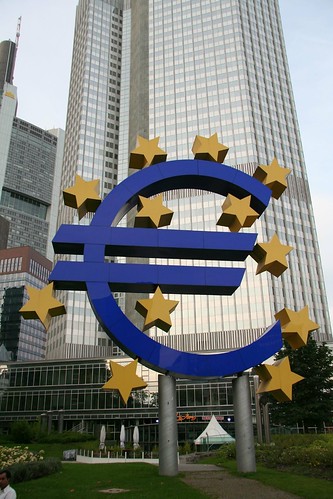
Image by irene

In spite of headlines talking about the collapse of the Euro, both Bulgarian and Swedish politicians have stated that they are looking to join the Eurozone, which seems suidical at a first look.

Thursday, January 14, 2010

Peaceful protest in Sofia

Today's protest against the ZES legislative project  were carried out peacefully and in a good mood, mediapool.bg reports. The meeting were attended by ca 300 protesters, among whom the SDS leader Martin Dimitrov.

Unlike last year, the meeting didn't create much interest in Bulgarian media, and even less in international... Borisov seem to have much bigger problems than protests in Sofia now, as his proposed Euro-commisar Rumiana Jeleva is being critizised for confict of interests.

Wednesday, January 13, 2010

Be careful tomorrow...

The protest against the ZES legislation will be carried out tomorrow, Bulgaria e Nasha reports. The authorities, Borisov's GERB party in various incarnation have used both whip and carrot to counter to protests.

Next to allowing traffic between protesters and parliament, a move that the protesters think of as sabotage, they yesterday announced changes in the legislation. Police authorities would in the adjusted text only get access to citizens data after after a judge's decision.

The protesters do not think that this is enough, and refer to their demands - the current legislation project should be abandoned, the ministry of interior should be reformed and if new legislation is necessary, the civil society should first be consulted.

The Bulgarian civil society is far from perfect though. Behind tomorrows protest stands 38 different organisations, that are found on the protest's homepage. It seems like anyone who supported the demands on the authorities could join the protest. Among the organisations I find some that I know are key actors in the Bulgarian civil society, like Elektronna Granitza or Zelenite, but there are also some names I am disappointed to see, like Асоциация Общество и Ценности (The Associaton for society and values), who use their homepage to openly propagate against the gay parade in Sofia, and claiming that "science" says that noone is born with sexuality, and Българската национално-радикална партия (The Bulgarian National-radical party), a minor organisastion who their web space to propagate conspiracy theories about how the jews were behind the bolsjevik revolution.

I don't see how organisations who struggle for a democratic, and European Bulgaria, can allow this kind of idiots to soil their projects. What do you think would be The Bulgarian National-radical party's stance on surveillance in case they had any power? My guess is that they would start b registering jews, and then everyone who talked with jews, and then everyone who talked with someone who knows a jew...

So here are my words for those protesting tomorrow: Be careful. I don't think there will be any violence in the streets, tomorrow you are fighting to be heard in media. You are so right abut this, but, please, be more careful about who you let demonstrate with you.

Tuesday, January 12, 2010

14/1 2010

14 January 2009 was the date when thousand of protesters, from various Bulgarian NGO's gathered in a protest against corruption and mis-government, bigger and stronger than anything the country had seen in years.

The crowd was eventually dispersed violently, something that caused an outcry among civil activists, and helped create a movement of youth calling for a truly democratic Bulgaria, centered around the blog Bulgaria e nasha.

In the following spring, much of the energy, not least at Bulgaria e nasha, was spent at fighting the ZES legislation, that would have given the ministry of interior direct access to citizens electronical data. In the wake of the police's actions at the protest, and with the ministry of interior's history in mind, activists were very concerned about surveillance. I understand them.

Against odds, the activists won. The then ruling socialist dominated coalition did not manage to get the parliament to accept the legislation, before it was ousted and replaced by Borisovs government.

But...

Dissapointed, and more or less surprised, the activists saw how Borisovs GERB, witht the support of Ataka, could easily lead the same legislation through the parliament witout any strong opposition. The same legislation that they had vehemently been against before (at least Ataka).

Therefore, at the 14 of January 2010, a new demonstration has been announced in front of the parliament, the place that hosted not only the demonstrations one year earlier, but also the storming of the parliament in 1997 and the protest against the communist leaders in 1989. The demands are as follows:
  1. The responsible  minister should immediately ask for the cancellation of the legislative project.
  2. Quick and thourough measures to make the MVR a modern instution meeting European standards
  3. In case legslative changes are necessary, these should be done first after consulting a wide range of civil interests and experts

Protests in front of the parliament has a strong symbolism, and is probably the last thing Borisov wants. So the Sofia mayor, who comes from his own GERB party, has declined to stop the movement of traffic on the square. The organisors of the protest calls this sabotage, from the mayors office it is said that a part of the square has been reserved for the protesters.

In East European politics, the capital mayors play an important role. Borisovs has managed to get full control over both Bulgaria and Sofia, which makes him unhealthy strong.

Friday, January 8, 2010

IFJ calls Bulgarian authorities to protect the free speech

"The International Federation of Journalists (IFJ) have called on Bulgarian authorities to investigate the murder of journalist Boris Nikolov Tsankov" - this is the headline in one of Serbias B92's articles tonight.

It goes on
"The IFJ says the murder of Boris will undermine investigative journalism in Bulgaria as organized criminal gangs try to intimidate media through show of force and violence."

and adds that the IFJ has been joined in its demands by the European Federation of Journalists.

It is obviously a problem that a writer is shot down in the center of Sofia, no matter what is his criminal record, but it is also very problematic when international organisations like the IJF reacts like this without investigating further who Bobi Tsankov was. He was not an investigative journalist. That doesn't mean, of course, that it is safe for investigative journalists to work in Bulgaria if they write about the maffia - if he can be killed so can anyone. The killing of Bobi Tsankov was a horrible murder. But it was not an attack on free media.

Thursday, January 7, 2010

Who was Bobi Tsankov

I must admit an error. Bobi Tsankov, who was killed in downtown Sofia on Tuesday, was not a journalist in the proper sense. He had published a few articles in not very renowned publications, and did some radio shows, but more than anything he is famous for being a criminal himself. He has been accused of frauds for millions, and have close ties to organized crime himself. After all, it was exactly those ties boasted that he would reveal. So the murder was maybe more of an inter-mafia showdown, than an open attack on free speech.

My mistake is completely due to not checking my sources before I write. It is elementary, I have done it before, but there is no excuse.

Unfortunately I was not the only one todo this mistake. In Bulgarian TV today, Bulgarians wonder how the international press spread eactly this point of view, without checking out who Tsankov really was. I am sure they did  not take their information from Maladets! BBC describes him as a "prominent crime journalist" Balkan Insigth use the neutral "Radio Host", while NY Times call Tsankov a "prominent radio journalist and the author of a book on Bulgaria's gangsters".

After all, poor Bobi did publish some articles, so calling him a journalist could possibly be justified, even if it is wrong. But from where did BBC and NYT learn that he was prominent?

Unfortunately, in most people'seyes, and in reports about murdered journalists, Bobi Tsankov willbe a journalist, and Bulgaria a country where journalists are killed, which is something much worse than a country where gangsters kill each other.  Sloppy writing, like this is, helps in building prejudices about a country that too few foreigners even bother to understand. I hope you can forgive Maladets!, but the BBC and NYT should be better.

The other side of the story is that a mafia murder was carried out in broad daylight in the very center of Sofia, which is bad enough.  Was Tsankov really going to reveal something, that was so sensitive? Or did someone within the organized crime want to show Borisov who really rules this country? I don't know...

Anyway, journalism should be about telling the truth, and using the label "journalist" for Bobi Tsankov is a bit too imaginative.

Tuesday, January 5, 2010

Bobi Tsankov gunned down in central Sofia

The Bulgarian radio journalist Bobi Tsankov, who has been covering the Bulgarian mafia was shot down in central Sofia today, media is reporting.

The fact that journalist can be gunned down, in the center of the city in the middle of day, speaks very bad about the freedom of press in Bulgaria. What makes the matter even worse is that this is the third fourth similar case since I personally took an interest in Bulgarian affairs (I moved to Bulgaria in December 2007). Three of them were journalists, one was a writer.

In today's Bulgaria, journalists are not risking their lives when they write about politics, but they do that when they write about organized crime. Which make the matter even more complicated. Organized crime is a strong force beyond any democratic control. As society fails to come to grips with that, the press is not free, no matter what the constitution says.

The Borisov government have carried out some widely talked about actions against criminal gangs, but as long as journalists are not safe, they need to prove what they can do. I hope that the people who were involved in the murder of Bobi Tsankov will be caught and judged. As long as they are free, Bulgaria has very deep problems.

Sunday, November 22, 2009

Refugees hostel attacked in Southern Sweden

This morning, right before 05.00 a fire was discovered outside a hostel for refugees in Vellinge, a neighbouring village to Malmö in souther Sweden. The night was rainy, and a police officer stoically commented "a fire doesn't start by itself in this weather".

I have recently written about this story. It goes like this:
  • Due to unknown factors many refugge children come to Sweden without their parents.
  • Most of them arrive in Malmö, because it is the southernmost entrance point to Sweden. (Most likely someone is paid to take them to Sweden, and drops them of once they cross the border)
  • Malmö can't find places to host the refugees, and have asked neighbouring municipalities to help.
  • Most of the neighbouring municipalities don't want to help Malmö, unless they get money from the state. The state mumbles something about human rights, responsibities etc. but without money on the table nothing happens.
  • Vellinge has a very outspoken mayor, who has told all media that he will not take over any problematic refugees from Malmö...
  • Malmö eventually paied a private company to host the refugees. Guess where the hostel is situated...
  • in Vellinge. A huge scandal occurs. The official Vellinge yells about their right to rule as they want, and that Malmö didn't inform them about the hostel. The rest of Sweden more less hypocritically accuse the Vellinge inhabitants of racism. Plenty of normal people who happen to live in Vellinge are embarrased and frustrated by the whole mess.
 And this night some racist tried to set the hostel on fire.


I find the whole story utterly disgusting. Putting the blame entirely on Vellinge is missing the point. After all, 15 Swedish municipalities make exactly the same statement as Vellinge, but they are not stupid enough to boast about it in the papers.

Thus, the whole story has developed into a power struggle between the state, Malmö and Vellinge, who all use these people who decided to come to Sweden for their political means. the traaditional "blame game" as we know it from Bulgarian (or other) politics.

In Bulgaria the politicians at least had the decency to argue about waste, in stead of treating real people like waste. But obviously that was a bigger crime in the European eyes. The European Comission has recently started a trial against Bulgaria over its garbage disposal in Sofia. Bulgaria has protested, and I must agree...  How about starting a trial against Sweden over its  refugee "disposal" in Malmö/Vellinge.

As any modern state Sweden has an obligation to defend human rights of all people staying on its territory. Swedish authorities now shamefully fail in safeguarding the most basic human rights of the refugees, including the 3rd article - the right to live.

The  UN's declaration of human rigths begins with statint that "All human beings are born free and equal in dignity and rights". I see no freedom. I see no equality. And most of all I miss seeing dignity.


Further reading:

If you read  Bulgarian, the situation of paperless immigrants have been discussed also in the Bulgarian blogsphere recently:


http://svetlaen.blogspot.com/2009/11/blog-post_09.html
http://svetlaen.blogspot.com/2009/11/blog-post_15.html
http://svetlaen.blogspot.com/2009/11/blog-post_17.html

Tuesday, November 17, 2009

Those Bulgarian women...


(picture from BGNES)

Sofia will be headed by a woman, for the first time in history. Sofia's new mayor(esse) is called Yordanka Fandakova, and she was the candidate of Borisov's GERB party, elected by more than 66 % of the capital's residents. Bulgarian women are strong and responsible, and it seems they increasingly becoming visible in politics.


Picture from wikipedia

Not long ago Irina Bokova was elected director of UNESCO, the highest international position a Bulgarian politician has held since the fall of communism.


In the spring Meglena Kuneva attracted voters en masse to NDSV, "the King's party", and raised hopes that the king himself failed to live up to in the national elections.

Obviously, those Bulgarian women has something going... Fandakov is not expected to go her own way - she is supposed to run Borisovs politics in the capital, but this doesn't make her position less influential. Obviously both GERB, the socialists and NDSV leaderships know how to benefit from brilliant women. (I dont know much about Fandakova, or Bokova but I have a good general impression of Kuneva).


In the article I link to initially, Ivan Dikov compares the election of Fandakov to "Napoleon making his brother Joseph Bonaparte King of Spain 200 years ago, or to Vladimir Putin making Dmitry Medvedev the next Russian President 2 of years ago"

Comparing the appointments of Fandakova, Bokova and Kuneva, some more things could be said. As a foreigner, it is very easy to understand how the old government of Socialists, NDSV and less so the ethnic turkish party merge with european and international elites. They look and feel like western politicians. They may not walk the walk but they talk the talk, and that is what matters on those heights.

Borisov on the other hand, may be doing all the right things, but quite frankly he still looks like a bodyguard to me. I suspect he does so also to my government at the EU-meetings.


On the streets of Sofia, however, people might be tired of nice words, and the election of Fandakova shows that the confidence in Borisov's offensive politics is still there. It also seems like Borisov is monipolizing the healthy right wing vote - both racist Ataka, and the liberal-rightist SDS and DSB backed Fandakova.

So, congratulations to Fandakova, congratulations to Borisov and most of all: congratulations to Bulgarian women - taking public space, and representing all political forces in the country.

Friday, September 4, 2009

Bulgaria - impressions roundup

As attentive readers know - I was about to move to Sweden. Now I am already here - the relative silence prevailing on maladets! was due to the rather demanding logistics of moving.

My girlfriend showed me this account from a foreigner living in Lund. As I am moving to the very same village, I take up the challenge, and try to sum up my own, highly subjective impressions from Bulgaria, arguably the EU's most corrupted and most beautiful country.

Sex

Sex, mostly in the form of more or less undressed women was everywhere, really. Chalga singers with swimsuits in the colour of water-melons... a store for bathroom interiors with a showering bare naked lady, life size, in the window. I laughed a lot about the melons the first time, but after three summers it was not so exciting. Moldova was very prudent in comparision. Sweden is a lutheran church.

Fast money

In Bulgaria, things happend fast and loud. Houses were built, magazines opened and closed. During my one and a half year in Sofia a thousand things changed, and yet it was pretty much the same in the end. The building projects, and most commercial undertakings smelled more of fast profits than corporate responsibility. But also at work, and in any kind of organized activities, I always had the impression that decisions were taken impulsively, often in a haste.

This contrasted to an impressive ability to relax in the face of huge problems. The ability to sit down, drink without getting drunk, laugh and take it cool. At the table, the Bulgarians struck me as a very elegant people.

Back to school


Coming back to Sweden in some way resembles being institutionalized. Foucault argued that the prison was the model of the entire industrialized society. I think in the case of Sweden it is more fair to say that the school is the model of the society. God knows what would make the model of Bulgarian society... In Bulgaria there is something of everything everywhere, and there is a feeling that anyone can do what they want.

Coming from Sweden, a country where people might earn ten times more than their neighbour but buy the same cheap clothes, and the same cheap food, it was very difficult to comprehend a society a city with big black jeeps, horse carts, and enviromentalists on bikes. All at the same time.

1994

In the history of the peoples, the 1994 Fotball World Cup was the Greatest. On this Bulgarians, Swedes and also Romanians agree. I talked a lot of football in Bulgaria. Especially Zlatan Ibrahimovic, very un-swedish in name as well as manners, was remembered by many Bulgarians. But we seldom agree on the details, like whether Stoichkov was a brilliant striker (Bulgarian history) or a crybaby who threw himself on the ground whenever he was within the penalty area (Swedish history).


Bulgaria was a country so differnet from what i knew before. How could I not miss it? At least a little bit...

Tuesday, August 25, 2009

Social justice

Casual conversation between with me and the woman who cleans the stairs outside our office:


-How are we today ?
-Just fine thanks, and you?
-Oh, I'm fine. No problems at all. What about you? Did you get your vacation yet?
-No, we don't get vacation
What do you mean? You haven't had it yet, or you don't get it at all?
-Nope. They don't give us any vacation.


Bulgarian labour legislation is comparable to European, and prescribes 20 days of vacation per year (I think). Someone is not honest here.... either this woman or her employer.