Sunday, November 22, 2009

Refugees hostel attacked in Southern Sweden

This morning, right before 05.00 a fire was discovered outside a hostel for refugees in Vellinge, a neighbouring village to Malmö in souther Sweden. The night was rainy, and a police officer stoically commented "a fire doesn't start by itself in this weather".

I have recently written about this story. It goes like this:
  • Due to unknown factors many refugge children come to Sweden without their parents.
  • Most of them arrive in Malmö, because it is the southernmost entrance point to Sweden. (Most likely someone is paid to take them to Sweden, and drops them of once they cross the border)
  • Malmö can't find places to host the refugees, and have asked neighbouring municipalities to help.
  • Most of the neighbouring municipalities don't want to help Malmö, unless they get money from the state. The state mumbles something about human rights, responsibities etc. but without money on the table nothing happens.
  • Vellinge has a very outspoken mayor, who has told all media that he will not take over any problematic refugees from Malmö...
  • Malmö eventually paied a private company to host the refugees. Guess where the hostel is situated...
  • in Vellinge. A huge scandal occurs. The official Vellinge yells about their right to rule as they want, and that Malmö didn't inform them about the hostel. The rest of Sweden more less hypocritically accuse the Vellinge inhabitants of racism. Plenty of normal people who happen to live in Vellinge are embarrased and frustrated by the whole mess.
 And this night some racist tried to set the hostel on fire.


I find the whole story utterly disgusting. Putting the blame entirely on Vellinge is missing the point. After all, 15 Swedish municipalities make exactly the same statement as Vellinge, but they are not stupid enough to boast about it in the papers.

Thus, the whole story has developed into a power struggle between the state, Malmö and Vellinge, who all use these people who decided to come to Sweden for their political means. the traaditional "blame game" as we know it from Bulgarian (or other) politics.

In Bulgaria the politicians at least had the decency to argue about waste, in stead of treating real people like waste. But obviously that was a bigger crime in the European eyes. The European Comission has recently started a trial against Bulgaria over its garbage disposal in Sofia. Bulgaria has protested, and I must agree...  How about starting a trial against Sweden over its  refugee "disposal" in Malmö/Vellinge.

As any modern state Sweden has an obligation to defend human rights of all people staying on its territory. Swedish authorities now shamefully fail in safeguarding the most basic human rights of the refugees, including the 3rd article - the right to live.

The  UN's declaration of human rigths begins with statint that "All human beings are born free and equal in dignity and rights". I see no freedom. I see no equality. And most of all I miss seeing dignity.


Further reading:

If you read  Bulgarian, the situation of paperless immigrants have been discussed also in the Bulgarian blogsphere recently:


http://svetlaen.blogspot.com/2009/11/blog-post_09.html
http://svetlaen.blogspot.com/2009/11/blog-post_15.html
http://svetlaen.blogspot.com/2009/11/blog-post_17.html

Tuesday, November 17, 2009

Those Bulgarian women...


(picture from BGNES)

Sofia will be headed by a woman, for the first time in history. Sofia's new mayor(esse) is called Yordanka Fandakova, and she was the candidate of Borisov's GERB party, elected by more than 66 % of the capital's residents. Bulgarian women are strong and responsible, and it seems they increasingly becoming visible in politics.


Picture from wikipedia

Not long ago Irina Bokova was elected director of UNESCO, the highest international position a Bulgarian politician has held since the fall of communism.


In the spring Meglena Kuneva attracted voters en masse to NDSV, "the King's party", and raised hopes that the king himself failed to live up to in the national elections.

Obviously, those Bulgarian women has something going... Fandakov is not expected to go her own way - she is supposed to run Borisovs politics in the capital, but this doesn't make her position less influential. Obviously both GERB, the socialists and NDSV leaderships know how to benefit from brilliant women. (I dont know much about Fandakova, or Bokova but I have a good general impression of Kuneva).


In the article I link to initially, Ivan Dikov compares the election of Fandakov to "Napoleon making his brother Joseph Bonaparte King of Spain 200 years ago, or to Vladimir Putin making Dmitry Medvedev the next Russian President 2 of years ago"

Comparing the appointments of Fandakova, Bokova and Kuneva, some more things could be said. As a foreigner, it is very easy to understand how the old government of Socialists, NDSV and less so the ethnic turkish party merge with european and international elites. They look and feel like western politicians. They may not walk the walk but they talk the talk, and that is what matters on those heights.

Borisov on the other hand, may be doing all the right things, but quite frankly he still looks like a bodyguard to me. I suspect he does so also to my government at the EU-meetings.


On the streets of Sofia, however, people might be tired of nice words, and the election of Fandakova shows that the confidence in Borisov's offensive politics is still there. It also seems like Borisov is monipolizing the healthy right wing vote - both racist Ataka, and the liberal-rightist SDS and DSB backed Fandakova.

So, congratulations to Fandakova, congratulations to Borisov and most of all: congratulations to Bulgarian women - taking public space, and representing all political forces in the country.

Wednesday, November 11, 2009

Welcome to Sweden

I remember last summer, laying on a beach at the Bulgarian Black Sea cost and spelling my way through an entire Kapital saturday issue. The topic of the issue was the waste-war between Sofia's mayor Bojko Borisov and the premier minister Sergei Stanishev hat raged on and on until Borisov replaced Stanishev as he leader of the Balkan country.

The problem in Bulgaria at the time,  was that the city Sofia produced much more waste than it could digest. Stanishev said that this was Borisov's fault, Borisov blamed Stanishev etc. Sofia wanted to dump the waste somewhere else, but no one wanted to accept the waste. Of course. Eventually a solution was found, where the waste is taken to the village Shishmanci where it will be processed in the European way.

I dont't think this story showed the gentlemen from their best sides, but unfortunately they arenot alone. Here in Sweden the same drama is now unfolding, only that the argue is about people treated like waste, and not waste given political significance.

Malmö is the biggest city in southern Sweden, and the obvious point of entry for refugees coming to Sweden from the continent. Lately there has been a great influx of children without families, for reasons that I don't know. The radio this morning said the number of single refugee children are currently around 90.

These kids come to Malmö, are put in a hotel, where they are supposed to stay for some days until a more suitable long-time housing solution is found. Unfortunately, finding a such solution have been a nightmare for the Malmö municipality. Eventually they hired places by a private company in the care business (otherwise working with mentally disabled, for example), in a smaller town nearby called Vellinge.

The Vellinge local politicians object and say that they don't want any refugees kids there. This is Malmö's problem, that Malmö should solve. One could mock the right wing mayor*, usually a staunch market fundamentalist, for messing up with what a private company in his municipality does. But unfortunately his socialist competitors agree with him on this issue. Citizens have also protested to show that they don't want anything else than blonde kids with rich parents playing on their streets.

This is one of the scary aspects of immigrant policy in Sweden - there is a conservative consensus spanning over all the biggest parties that ensure that exactly this policy is not affected by elections.

What is not scary, but shameful, is the narrow mindedness of the Vellinge politicians. Vellinge happens to be one of Sweden's richest municipalities, i.e. one of the richest in the world. They don't have any social problems compared to other places in southern Sweden like Malmö or Landskrona. They have 3,6 % unemployment when the national ratio is 8,4 %. If vellinge can not afford to help these children, who on earth can?

The protests show the great Western misunderstanding that everyone comes here, as if these 90 children were all refugees in the world. The greatest numbers of refugees still live in very poor countries neighbouring their home countries, and we are simply helping out, as little as we can.

The scandal that is now played up in national media is a huge disgrace, not much different from the Bulgarian waste scandal.  But we are talking living, vulnerable children, that need any help they can get. But at least we are processing them in the European way...

*We don't really have mayors in Sweden, but I use the word for convenience. He has a similar position.

Tuesday, November 10, 2009

Yesterday - a day to remember.

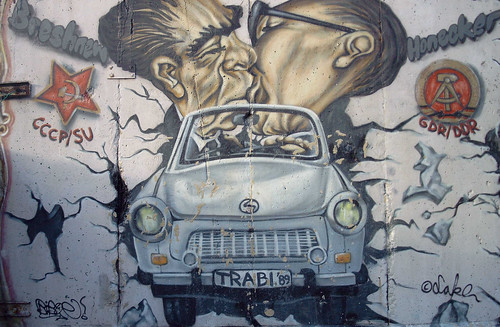
Yesterday Germans and Europeans celebrated the fall of the Berlin wall 20 years ago. While one could argue against the single minded focus on DDR here in Sweden, at the expense of other ex-conmmunist countries, there is no doubt that this is a date to remember.


Picture from creative commons, credits to backkratze


The wall was a very strong symbol for the Europe that once existed on both sides of it. The Sex Pistols sang about it. So did the Swedish punks Ebba Grön. And its fall  was probably the strongest symbol of a revolution we all lived through, in one way or another. I am no doubt west european, but we also lived through this period in history, albeit on the other side of things.

20 years later one can pretty much choose between seeing how much has changed - the maladets! blog itself is an evidence of an european continent without efficient borders*. One could likewise despair how little has actually changed. In spite of Moldova not existing 20 years ago, the newly ousted president Voronin did, and held executive powers in the soviet republic Moldova.

Yes... the post-sovietic countries didn't develop as quick or in the ways that the world expected 1989. Old elites managed to stay in power, but history didn't rest. The last couple of years we have seen progressive upheavals in several countries with less than perfect democracies - Ukraine, Georiga, Moldova and I would say also Bulgaria, even if the revolution took place in a normal election.

These revolutions were driven by the strongest force in life - youth. Eastern European countries now see the first generation born after communism mature, with new expectations. They carry on the good work  their parents did 20 years ago, and I think these Europeans are the one's we should remember now.

This post goes out to you, Bulgarian bloggers, environmentalists, Moldovan peaceful democracy protesters and all other heroes I never had the chance to meet.

*There are bordes, but they apply only to those with the wrong passport. The border between Moldova and Romania is open for me, while closed for Moldovans.

Monday, November 2, 2009

Turkish delinquents sentenced to reading Tolstoj

I tend to think that the EU should join Norway, but maybe Turkey is an alternative?

According to the Moldovan blogger Gheorghe Erizeanu, one of my favourite romanian language blogs, the turkish authorities have started to sentencing minor offenders to - reading.  The source is the libanese daily Courier International.

The first case was a man guilty of being punk in drublic, disturbance of the public order etc. , berserking like a Swede on a Friday night.

The culprit was sentenced to reading War and Peace by Tolstoj, under the surveillance of guards, and later writing a short review of what he had been reading. He read 1,5 hrs a day during one month, and as far as I understand he was not obliged to finish the book in this time. Just read.


Tolstoj, picture from Creative Commons


I would so much like to read the rependant's review of war and peace, and I can't stop thinking what society would look like if we forced criminals to read classical litterature. Who chooses the books? Would the criminals be the most well versed in classical litterature after some years? Would young lads read War and Peace, so that they can fool their younger mates into believing that they have lived the hard life?

Seriously... reading War and Peace wouldn't scare me from robbing little old ladies, quite on the contrary. It's a great book, and this sounds like the way to get time to read it :)