Thanks to my better half Annie, I encountered one more excellent example of Bulgarian social blogging - Neyjoten blog (Inconvenient blog)
In a post called "Why I will not vote for Bogo and Zelenite in the European elections", the blogger Svetla Encheva make some very important points.
Svetla is a personal friend of Bogo, Bogomil Shopov that I have often referred to myself. Bogo is now a candidate for Zelenite in the elections to the European Parliament.
The reason for Svetla to object is not that she can't agree with Bogo. On the contrary, she does agree with Bogo and Zelenite, and thank them for a number of things. Bogo has for example been one of the leading characters in the struggle for internet freedom in Bulgaria, that I have reported on before on Maladets!. But as Svetla says "I would rather see Bogo as a citizen than as a politician". This is a profound truth about democracy. A democracy needs active citizens outside the parliament to work. The most active citizen is not necessary the best politician.
The other reason, that Svetla discusses into lenght, is that Bogo is on the list of Zelenite, and she can't support them. For the following reasons:
Zelenite is, and should remain a social movement, not political party. In deed, as Svetla highlights, one thing that makes Zelenite attractive to many young voters is the fact that they are generally not regarded as politicians. The difference between social movements and parties, according to Svetla, is that the former defend the interest of smaller groups than the latter.
A party also verbalizes the interest of a group, but much bigger. For example it's difficult to generate support for a party for elderly, whereas groups defending the rights of retired are normal, and in deed necessary in society.
When Zelenite goes to elections, it does it as a competitor to the blue coalition, and since their political demands are close, they will generally compete for the same voters in stead of uniting them in a strong alternative.
There is no chance that Zelenite actually will make it to the European parliament. In polls Zelenite is not an alternative, but the alternative "other" usually gets between 1 and 2 %.
This is my summary of Svetla's text. The relevance is proven by the massive interest - the post, posted at 5th of May, today two weeks later had more than 67 long comments.
First of all - I believe that Svetla is wrong. There is a real chance for anything to happen, when 25% of the electorate claim that they will not vote or do no know. I would not be overly surprised if Zelenite and the blue coalition find each other before the elections eithe.
The critique she words against Zelenite I have heard before about the green party in Sweden, and I think this is the critique that every new party will face. All parties grow out of social movements. For sure they will have to evolve into something else later. Some do, some don't. But I can not see any reason why Zelenite would not.
But... Svetle is also right. The difference between a social movement and a political party is in real and vital. Zelenite must choose what to be, and if they decide to be a political party, Bulgaria definitely needs a social movement that can take their place. As a political party they will have to make compromises. But someone must be free to say the truth no matter of the political implications. To make a concrete exampe - the party Zelenite might have to prioritize which Bulgarian national park is the most important to save. A non-governmnental environmental organisation should not and must not do such choices.
As a party they will also have to choose their allies. For now the relationship between Zelenite and the blue coalition is rather unclear. There is a facebook group arguing for Zelenite to join the coalition, and it is difficult to imagine any other partners in Bulgarian politics. But a cooperation should either be more substantial than a Facebook group, or fair competition.
Thanks Svetle, for a thought provoking text! :)
Wednesday, May 27, 2009


Tuesday, May 26, 2009
Goat Milk 1989 - 2009
I spent the weekend in the best way possible - with my girlfriend Annie in a tent not too high in the Bulgarian mountains. Not only did we have good weather, and a terrific nature around us - the village where we camped , Bela Reka was also the site of a cultural festival in North western Bulgaria called Goat Milk.The t heme of the festival was 1989 - our places of memory.
Anna in the tent
A number of work shops were held, dealing with the historical memory through theatre , art etc.
Unfortunately I did not attend more than a few, interesting seminars.

Gregor and his translator.
The first seminar I attended was a kind of presentation of the events in Berlin 1989, told by the (West) German writer Gregor Mirwa. The interesting thing here was obviously the Europan perspective. To me 1989 is something else than a year in East European history. It is rather the moment when Eastern, Northern, Southern and Western Europe's histories met at a crossroad to separate on slighltly different paths again. I find it very very insightful to compare my impressions from this time with those of other Europeans. But it's not so easy to come there, and I think Gregor's seminar would have benefited from stricter moderation.
That being said, moderation is seldom the strong side at Bulgarian events, and maybe not the most important thing at a festival... after all we were not there to work :)
After Gregor followed an emotional presentation of the Iranian born photographer living in Canada Babak Salari's photos from Afghanistan. Salari was highly critical of NATO's involvement in the country, a fact that would have been interesting to discuss. After all Bulgaria is a member of NATO and do have a military presence in Afghanistan. I would also have loved to hear how he experienced 1989 as an Iranian refugee in Canada.
The last seminar I and Annie attended was extraordinary interesting, in fact. Evgeny Mihajlov who was an active cameraman in the magical year screened his original footage from the events in the winter of 1989/90. One could smell a different time in the idealism of the demands, and the sense of a new world order.
The discussion inevitably steered towards today's protesters, and the reason why today's protests gather at most 1000 protesters. I believe it is much too easy to see the similarities and forget the differences back then. I spoke about it with my girlfriend afterwords, and she pointed out that the world in 1989 was a very idealistic place - there as revolution in the air. The problems now are more local to Bulgaria and do not inspire the same emotions. I think it is also important to bear in mind the difference between a handicapped democracy and a real totalitarian society.
Mihajlovs pictures reminded me that nothing was decided in December 1989. No one knew for sure that democracy would win. The protesters had so much to win. And also so much to lose. After going out in the streets like that they could probably kiss all dreams of a career or freedom to speech good bye, had they lost. I fear this is exactly what is happening in Moldova today.
The rest of the evening was sent with local food and cosmopolitan food. The festival was quite cosmopolitan actually, I met three girls from Norway that ran a similar festival in the West of Norway. Sometimes I believe Europe is possible.
Beautiful...
 heme of the festival was 1989 - our places of memory.
Anna in the tent
A number of work shops were held, dealing with the historical memory through theatre , art etc.
Unfortunately I did not attend more than a few, interesting seminars.

Gregor and his translator.
The first seminar I attended was a kind of presentation of the events in Berlin 1989, told by the (West) German writer Gregor Mirwa. The interesting thing here was obviously the Europan perspective. To me 1989 is something else than a year in East European history. It is rather the moment when Eastern, Northern, Southern and Western Europe's histories met at a crossroad to separate on slighltly different paths again. I find it very very insightful to compare my impressions from this time with those of other Europeans. But it's not so easy to come there, and I think Gregor's seminar would have benefited from stricter moderation.
That being said, moderation is seldom the strong side at Bulgarian events, and maybe not the most important thing at a festival... after all we were not there to work :)
After Gregor followed an emotional presentation of the Iranian born photographer living in Canada Babak Salari's photos from Afghanistan. Salari was highly critical of NATO's involvement in the country, a fact that would have been interesting to discuss. After all Bulgaria is a member of NATO and do have a military presence in Afghanistan. I would also have loved to hear how he experienced 1989 as an Iranian refugee in Canada.
The last seminar I and Annie attended was extraordinary interesting, in fact. Evgeny Mihajlov who was an active cameraman in the magical year screened his original footage from the events in the winter of 1989/90. One could smell a different time in the idealism of the demands, and the sense of a new world order.
The discussion inevitably steered towards today's protesters, and the reason why today's protests gather at most 1000 protesters. I believe it is much too easy to see the similarities and forget the differences back then. I spoke about it with my girlfriend afterwords, and she pointed out that the world in 1989 was a very idealistic place - there as revolution in the air. The problems now are more local to Bulgaria and do not inspire the same emotions. I think it is also important to bear in mind the difference between a handicapped democracy and a real totalitarian society.
Mihajlovs pictures reminded me that nothing was decided in December 1989. No one knew for sure that democracy would win. The protesters had so much to win. And also so much to lose. After going out in the streets like that they could probably kiss all dreams of a career or freedom to speech good bye, had they lost. I fear this is exactly what is happening in Moldova today.
The rest of the evening was sent with local food and cosmopolitan food. The festival was quite cosmopolitan actually, I met three girls from Norway that ran a similar festival in the West of Norway. Sometimes I believe Europe is possible.

Beautiful...
Thursday, May 21, 2009
Justice po Shvedski
Imagine that you have a dad that tend to end up in problem with other people. Imagine that he one day ends up beating another guy up pretty badly, but you don't know if he attacked or defended himself or when the defense became an attack... Bad things happen, don't they? I guess most of us would be able to forgive our dad also this. We might even accept that he has to spend years in jail. But could you imagine that you and your entire family would to go to jail for what your dad had done?
Readers that have vivid memories of Eastern Europe under communist rule, including today's Moldova, might not have too big difficulties imagining even this. But who would imagine that this is happening in Sweden. The year is 2009.
The story has caused quite a lot of media attention in Sweden, more about that later. Recently Maciej Zaremba, a polish born Swedish journalist I hold in high esteem, published an article about what is definitely one of the most rotten juridical scandals in Sweden in modern times. It is called "Another view of Vojakkala".
The village Vojakkala is located in the very very north of Sweden, were people don't speak Swedish but a dialect of finnish called Meänkäli . As you might well imagine, this place is surrounded by myths about men who drink vodka and kill each other with knife from time to time. There is no chance for any police to know what actually happens there. So who would be surprised by a feud between neighbours? That's what those people do, isn't it?
Yes, there is a feud. On the one hand we have the odd family Grönfors. On the other hand a mafiotic group of villagers that claim that the Grönfors destroy their village, and therefor during years have boycotted them. The Grönfors' have not been able to shop in the store in their village store, or to fix cars in the village for years. Because they are... Grönfors.
13 May 2008 one of the neighbours, let's call him S, parked his car outside Grönfors house.S hated the Grönfors more than anyone else did. Strangely enough had gone to some length to hire the house next to theirs.
He walks out of the car and gets beaten down by Allan Grönfors. With an axe. This gives Allan eight years in jail. Fair enough I guess. Allan's sisters get eight months of jail for protecting him, and his brother and father gets 6 years each for planning and helping Allan. In Sweden you get 10 years for murdering someone, but the family Grönfors are sentenced en masse to 22 years of jail. Almost "a 25er" with Solemnization's words.
And after all there are som worrying details. The fact that the murdered S shows up in court with a bandage but as live as I am writing this might indicate that Allan didn't really try to kill him. If you try to kill someone with an axe and fail your a pretty lousy murderer. Allan said that he was afraid and acted in self defense. The two guns and 36 bullets found in S's pockets might indicate he was not there for a cup of coffee.
The Grönfors were not a normal family. Allan had problems with communicating with people and preferred to communicate with animals. The only person he could related to was his mother. The mother died and was buried in Finland. Allan used to travel 350 km every day to visit her grave.
Those who need a word for it say that he had Asbergers syndrome, a light for of autism. Everyone knew that Allan was odd. But if you left him alone he didn't trouble you.
Also S had a history, of course. He was not supposed to be on the spot at all, actually. The police had banned him from coming anywhere near Grönfors, after a serie of verbal attacks and threats. For example he put up loudspeakers next to Grönfors house, saying that he had take his mother from the grave and what he had did with her. Etc. etc.
S was maybe the most active in the anti-Grönfors camp. But he was not alone. A mafia of local shop owners backed him. On internet forums like this it was discussed on how the Grönfors should be dealt with.
Interestingly, none of the close neighbours, except for S himself have had any problems at all with the family.
This could have been just a tragedy. But in stead it turned into a scandal, when the court put some strange sense of "order" above law, and refused to listen to the defendants. It preffered to listen to an angered local opinion that wanted someone punished. An opinion that was served exactly what they wanted by mud crawling local and national media.
This story left such a bad taste in my mouth. It is a shame for Sweden, a country with a good reputation in other European countries. A reputation we owe to people like Zaremba.
Maciej Zaremba is one of the few that has stood up in this case. Not for Grönfors, but for justice. The family was not punished for the crimes committed but for who they were. They were Grönfors. And they were roma.
Readers that have vivid memories of Eastern Europe under communist rule, including today's Moldova, might not have too big difficulties imagining even this. But who would imagine that this is happening in Sweden. The year is 2009.
The story has caused quite a lot of media attention in Sweden, more about that later. Recently Maciej Zaremba, a polish born Swedish journalist I hold in high esteem, published an article about what is definitely one of the most rotten juridical scandals in Sweden in modern times. It is called "Another view of Vojakkala".
The village Vojakkala is located in the very very north of Sweden, were people don't speak Swedish but a dialect of finnish called Meänkäli . As you might well imagine, this place is surrounded by myths about men who drink vodka and kill each other with knife from time to time. There is no chance for any police to know what actually happens there. So who would be surprised by a feud between neighbours? That's what those people do, isn't it?
Yes, there is a feud. On the one hand we have the odd family Grönfors. On the other hand a mafiotic group of villagers that claim that the Grönfors destroy their village, and therefor during years have boycotted them. The Grönfors' have not been able to shop in the store in their village store, or to fix cars in the village for years. Because they are... Grönfors.
13 May 2008 one of the neighbours, let's call him S, parked his car outside Grönfors house.S hated the Grönfors more than anyone else did. Strangely enough had gone to some length to hire the house next to theirs.
He walks out of the car and gets beaten down by Allan Grönfors. With an axe. This gives Allan eight years in jail. Fair enough I guess. Allan's sisters get eight months of jail for protecting him, and his brother and father gets 6 years each for planning and helping Allan. In Sweden you get 10 years for murdering someone, but the family Grönfors are sentenced en masse to 22 years of jail. Almost "a 25er" with Solemnization's words.
And after all there are som worrying details. The fact that the murdered S shows up in court with a bandage but as live as I am writing this might indicate that Allan didn't really try to kill him. If you try to kill someone with an axe and fail your a pretty lousy murderer. Allan said that he was afraid and acted in self defense. The two guns and 36 bullets found in S's pockets might indicate he was not there for a cup of coffee.
The Grönfors were not a normal family. Allan had problems with communicating with people and preferred to communicate with animals. The only person he could related to was his mother. The mother died and was buried in Finland. Allan used to travel 350 km every day to visit her grave.
Those who need a word for it say that he had Asbergers syndrome, a light for of autism. Everyone knew that Allan was odd. But if you left him alone he didn't trouble you.
Also S had a history, of course. He was not supposed to be on the spot at all, actually. The police had banned him from coming anywhere near Grönfors, after a serie of verbal attacks and threats. For example he put up loudspeakers next to Grönfors house, saying that he had take his mother from the grave and what he had did with her. Etc. etc.
S was maybe the most active in the anti-Grönfors camp. But he was not alone. A mafia of local shop owners backed him. On internet forums like this it was discussed on how the Grönfors should be dealt with.
Interestingly, none of the close neighbours, except for S himself have had any problems at all with the family.
This could have been just a tragedy. But in stead it turned into a scandal, when the court put some strange sense of "order" above law, and refused to listen to the defendants. It preffered to listen to an angered local opinion that wanted someone punished. An opinion that was served exactly what they wanted by mud crawling local and national media.
This story left such a bad taste in my mouth. It is a shame for Sweden, a country with a good reputation in other European countries. A reputation we owe to people like Zaremba.
Maciej Zaremba is one of the few that has stood up in this case. Not for Grönfors, but for justice. The family was not punished for the crimes committed but for who they were. They were Grönfors. And they were roma.
Tuesday, May 19, 2009
Democracy is coming...
Democracy is a strange thing, in deed. Svetla Dimitrova, head of the election authority ЦИКЕП (read TsIKEP), have written a letter to the Parliament, expressing her discontent with a statement from the parliament dating to the 13th of April.
The parliament was not pleased with ЦИКЕП's proposal to raise the barrier for coalitions to 8 %, and as I understand this is what this is about.
The parliament which is increasingly defiant since the third government party, the conservatives, tend to go against their coalition partners in the parliament, and rather vote with the parties in the blue coalition.
With an 8% barrier, the blue coalition would risk ending up outside the parliament. According to the last polls* I've seen the blue coalition have around 6%. Most analyst's sees this proposal as a try from the government to unduly use their legislative power agianst the opposition.
ЦИКЕП's decision was eventually faulted by the administrative court, which is the highest instance in this case.
One could quite easily see a pattern here: The government parties and certain authorities vs. the parliament, the local authorities in Sofia and the administrative court. the pattern i strinkingly similar to the situation in Republic of Moldova, but there the parliament is under control by the communist government.
For sure there are also business interests tied to the government, I would guess that there are interests tied to the opposition as well. The economedia group, which published the high class newspapers capital and Dnevnik, are very close to the blue alliance opposition.
Many bulgarians engaging in the politics expect some kind of silent revolution from the elections, by voting in new voices in the parliament. The defiant parliament is already now appearing as somehow less corrupted than the institutional establishment.
Now, the point of Svetla Dimitrova's letter is that ЦИКЕП is the responsible authority in this case, and that it is not the parlimentary majority's role to mix up in her work... this is a point that can be argued I think.
The Bulgarian constitution prescribes a very high degree of independence for different institutions, much higher than in Sweden for example. Much critique has ben aimed at the juridical system, but in fact the Bulgarian politicians have very small power to change anything, since they are banned form interfering with the courts.
In this case one democratic principle - the power comes from the elected parliament is ocunteracted by another principle, fundamental to liberal democracy - the independence of courts and other instutions. Democracy is a complex thing. In deed.
The parliament was not pleased with ЦИКЕП's proposal to raise the barrier for coalitions to 8 %, and as I understand this is what this is about.
The parliament which is increasingly defiant since the third government party, the conservatives, tend to go against their coalition partners in the parliament, and rather vote with the parties in the blue coalition.
With an 8% barrier, the blue coalition would risk ending up outside the parliament. According to the last polls* I've seen the blue coalition have around 6%. Most analyst's sees this proposal as a try from the government to unduly use their legislative power agianst the opposition.
ЦИКЕП's decision was eventually faulted by the administrative court, which is the highest instance in this case.
One could quite easily see a pattern here: The government parties and certain authorities vs. the parliament, the local authorities in Sofia and the administrative court. the pattern i strinkingly similar to the situation in Republic of Moldova, but there the parliament is under control by the communist government.
For sure there are also business interests tied to the government, I would guess that there are interests tied to the opposition as well. The economedia group, which published the high class newspapers capital and Dnevnik, are very close to the blue alliance opposition.
Many bulgarians engaging in the politics expect some kind of silent revolution from the elections, by voting in new voices in the parliament. The defiant parliament is already now appearing as somehow less corrupted than the institutional establishment.
Now, the point of Svetla Dimitrova's letter is that ЦИКЕП is the responsible authority in this case, and that it is not the parlimentary majority's role to mix up in her work... this is a point that can be argued I think.
The Bulgarian constitution prescribes a very high degree of independence for different institutions, much higher than in Sweden for example. Much critique has ben aimed at the juridical system, but in fact the Bulgarian politicians have very small power to change anything, since they are banned form interfering with the courts.
In this case one democratic principle - the power comes from the elected parliament is ocunteracted by another principle, fundamental to liberal democracy - the independence of courts and other instutions. Democracy is a complex thing. In deed.
Monday, May 18, 2009
Think globally - act locally
Democracy is a strange thing, much like love. On the one hand it is about putting global interests, of society, of the planet ahead of your own. On the other hand it is about expressing your own opinion, and defy central ruling.
I believe actually, that there is a kind of contradiction - the bigger the society, the more despotic central ruling will be, which is why the concept of a democratic Europe is so much more difficult than a democratic Sweden or a democratic Bulgaria.
The citizens in Pomorie have used their democratic rights, and voted about an oil pipeline that was projected to go through their county. The answer was a huge NO! , whith 98,97 % of 14.900 votes against the proposition, Dnes reports.
As happy as the enviromentalists might be about the outcome, numbers like these are usually associated with "free elections" in communist states, so they don't speak well about the local democracy to me. I sort of pity the 153,47 guys who voted yes. I'm from the countryside, so I know that everyone will know who theya re, and let them know...
That said, I would have voted no myself.
Nonetheless, more decisions taken locally is the only way to counteract expolitation of the nature. And it would greatly enhance the Bulgarian, and European democracy.
In Varna, Zelenite have held discussions with local citizens on the topic "The citizen and the power - how can we influence the movement of society and the politics" (That is sort of a litteral translation.) See the pictures here.
BlueLink.net have launched a campaign for internet freedoms. Bluenet usually does not campaign, but provide internet resources for NGO's, but since they feel that their work is threatened by legislation, they have chosen to take a stand.
On their webpage they explain why in an english post. It gives a nice background to civil movements in Bulgaria, points out the pivotal role of the Internet in the new generation of protest movements that are the topic of this blog, and gives quite an optimistic view of this generation.
Read the text, and in case Maladets! is your houshold newssource for Bulgarian NGO's, I suggest that you update with an rssfeed with BluLink's news in English.
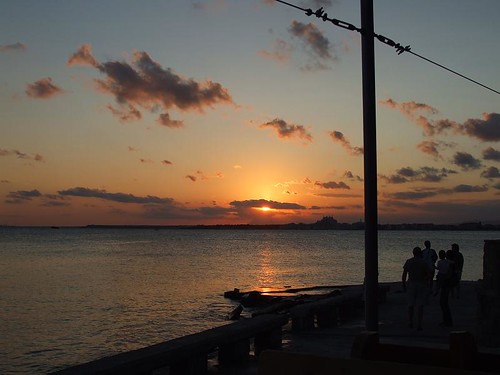
Sunset over Pomorie. Picture taken by NIKO. Taken from creativecommons.org
I believe actually, that there is a kind of contradiction - the bigger the society, the more despotic central ruling will be, which is why the concept of a democratic Europe is so much more difficult than a democratic Sweden or a democratic Bulgaria.
The citizens in Pomorie have used their democratic rights, and voted about an oil pipeline that was projected to go through their county. The answer was a huge NO! , whith 98,97 % of 14.900 votes against the proposition, Dnes reports.
As happy as the enviromentalists might be about the outcome, numbers like these are usually associated with "free elections" in communist states, so they don't speak well about the local democracy to me. I sort of pity the 153,47 guys who voted yes. I'm from the countryside, so I know that everyone will know who theya re, and let them know...
That said, I would have voted no myself.
Nonetheless, more decisions taken locally is the only way to counteract expolitation of the nature. And it would greatly enhance the Bulgarian, and European democracy.
In Varna, Zelenite have held discussions with local citizens on the topic "The citizen and the power - how can we influence the movement of society and the politics" (That is sort of a litteral translation.) See the pictures here.
BlueLink.net have launched a campaign for internet freedoms. Bluenet usually does not campaign, but provide internet resources for NGO's, but since they feel that their work is threatened by legislation, they have chosen to take a stand.
On their webpage they explain why in an english post. It gives a nice background to civil movements in Bulgaria, points out the pivotal role of the Internet in the new generation of protest movements that are the topic of this blog, and gives quite an optimistic view of this generation.
Read the text, and in case Maladets! is your houshold newssource for Bulgarian NGO's, I suggest that you update with an rssfeed with BluLink's news in English.
Sunset over Pomorie. Picture taken by NIKO. Taken from creativecommons.org
Sunday, May 17, 2009
European
The European elections are coming up, and so far things have gone as planned for the Bulgarian "alternative" politicians. Parts of them stand behind Zelenite that have managed to raise money and will participate.
Other parts stand behind SDS that finally registered within the blue coalition, after the administrative court had its say.
The administrative court also ruled against the government's proposal to raise the entrance barrier for coalitions to 8 %. Obviously the government parties do not have power over this court, which is the highest Bulgarian court.
I guess I should take on a somehow broader perspective, after all these elections are not about Bulgaria, but about Europe. I have lived all my life closer than 200 km from the EU border which i guess gives a certain perspective... From this border it is very clear that EU very soon has to understand what it is and what it it not. To put things clear - should EU have a common policy against Russia? Or another issue, that will be increasingly pressing - what should the relationship be between the EU and Turkey?
This kind of question will not be decided in the European parliament, and I guess this is why quite few people bothers to vote. After all, the Swedish government's opinion in this matters weigh much heavier than the EU parliamentarians.
Other parts stand behind SDS that finally registered within the blue coalition, after the administrative court had its say.
The administrative court also ruled against the government's proposal to raise the entrance barrier for coalitions to 8 %. Obviously the government parties do not have power over this court, which is the highest Bulgarian court.
I guess I should take on a somehow broader perspective, after all these elections are not about Bulgaria, but about Europe. I have lived all my life closer than 200 km from the EU border which i guess gives a certain perspective... From this border it is very clear that EU very soon has to understand what it is and what it it not. To put things clear - should EU have a common policy against Russia? Or another issue, that will be increasingly pressing - what should the relationship be between the EU and Turkey?
This kind of question will not be decided in the European parliament, and I guess this is why quite few people bothers to vote. After all, the Swedish government's opinion in this matters weigh much heavier than the EU parliamentarians.
Tuesday, May 12, 2009
Casino...
The story about SDS - Blue coalition continues... I was away for a weekend trip to Paris. Last thing I read before i left was that SDS had expelled Plamen Jorukov because of his try to register SDS alone outside the blue coalition.
On the plane back i read in Standart that the eletoral authorities had registered Jurokov's SDS, and not the blue alliance. But Jurokov was not a member any more, right?
Anyway, today I read in dnes.bg that the administrative court, the highest legal instance have changed the decision and registered the blue alliance for the elections.
The European elections this is. I guess Bruxelles should rejoice over this proven stong interest in the European elections, as interest is waining elsewhere. The parliament has published a site with key issues in the elections, in order for people to know what they vote about. The list is more than vague with points like How should our food be grown? and How should we help balance family and career?.
The first question is no doubt relevant, but... do you sincerely believe that a parliament whith green parties had 51 % majority could turn central European industrial farms into small scale family farms, adopting a regional self sufficience? I don't think so. What concrete politice measures are we actually supposed to discuss?
I also doubt that the European Parliament is the right instance to help me balance career and family. I might idealise the traditional social democratic societies at times, but for sure there should also the limits for the state.
The PR campaign for the EU elections has also been critizised in Financial Times' Brussels Blog and a view from the outfield blog. The latter adds literary beauty to the insights of the former.
On the plane back i read in Standart that the eletoral authorities had registered Jurokov's SDS, and not the blue alliance. But Jurokov was not a member any more, right?
Anyway, today I read in dnes.bg that the administrative court, the highest legal instance have changed the decision and registered the blue alliance for the elections.
The European elections this is. I guess Bruxelles should rejoice over this proven stong interest in the European elections, as interest is waining elsewhere. The parliament has published a site with key issues in the elections, in order for people to know what they vote about. The list is more than vague with points like How should our food be grown? and How should we help balance family and career?.
The first question is no doubt relevant, but... do you sincerely believe that a parliament whith green parties had 51 % majority could turn central European industrial farms into small scale family farms, adopting a regional self sufficience? I don't think so. What concrete politice measures are we actually supposed to discuss?
I also doubt that the European Parliament is the right instance to help me balance career and family. I might idealise the traditional social democratic societies at times, but for sure there should also the limits for the state.
The PR campaign for the EU elections has also been critizised in Financial Times' Brussels Blog and a view from the outfield blog. The latter adds literary beauty to the insights of the former.
Wednesday, May 6, 2009
How much does an election cost?
Social struggles turn into political, as Bulgaria rapidly moves towards two elections: to the national and the European parliament. The ecologists are focusing their work on the party Zelenite. At the moment the movement is looking for funds.
To register a party, or a coalition, you need to deposit 50 000 Leva per election (25 000EUR) To participate in both, Zelenite thus need 100 000 leva. Llast thing I heard, they had managed to collect more than 30 000 leva. Oddly enough, after deposing these money, the electoral campaign is not allowed to cost more than 200 000 leva.
For the blue coalition, it is still unclear whether SDS will be registered alone, or in coalition with DSB in the Europan elections. The legislatve authorities are still pondering.
While they are thinking, the campaign has started. Here is one poster from the blue coalition, depicting the socialists, DSP and the kings party as the losers of a football match. The poster is signed by the blue coalition.
Today is St George's day, a public holiday in Bulgaria. I am writing from a park where kids and parents enjoy the mellow May weather. Before we all watched the Bulgarian army on parade. The best part was, no doubt the orhestras, Bulgarian and international. International guests were foremost NATO partners, but also Russia, Ukraine and... The Republic of Moldova...

To register a party, or a coalition, you need to deposit 50 000 Leva per election (25 000EUR) To participate in both, Zelenite thus need 100 000 leva. Llast thing I heard, they had managed to collect more than 30 000 leva. Oddly enough, after deposing these money, the electoral campaign is not allowed to cost more than 200 000 leva.
For the blue coalition, it is still unclear whether SDS will be registered alone, or in coalition with DSB in the Europan elections. The legislatve authorities are still pondering.
While they are thinking, the campaign has started. Here is one poster from the blue coalition, depicting the socialists, DSP and the kings party as the losers of a football match.
 The poster is signed by the blue coalition.
Today is St George's day, a public holiday in Bulgaria. I am writing from a park where kids and parents enjoy the mellow May weather. Before we all watched the Bulgarian army on parade. The best part was, no doubt the orhestras, Bulgarian and international. International guests were foremost NATO partners, but also Russia, Ukraine and... The Republic of Moldova...

Monday, May 4, 2009
Politics worthy of the EU?
The Bulgarian has set off in a Balcanesque manner.
As I think readers of this blog have understood, to two main liberal parties SDS and DSB are entering the campaign in an alliance, called the blue alliance.
The alliance was not very popular with all members in the parties. I am not at all well informed in this question, but they are obviously two parties, and there is some reason behind this.
SDS, which is the most vocal part in the coalition, headed by Martin Dimitrov, claim that the ruling coalition of DPS (Turkish minority party) and BSP (Socialists) fight the coalition with ALL. forces. This is inetselg quite natural, but according to Dimitrov and other liberal voices, the ruling parties do not abstain from using state institutions to remain in power.
Recently, the ex-leader of SDS, Plamen Jurokov, registered SDS as running for elections ALONE, i.e. against the will of the current leader Marin Dimitrov.
The story has of course angered the liberals. Martin Dimitrov has described the situation as a war between the blue alliance and DPS and BSP. He sees the hands of DPS/BSP behind Jurokov's odd behavior, and say that if the Blue Alliance is not registered immediately, Bulgaria is not a worthy EU member.
Plamen Jurukov, and nine other SDS members have been excluded from the party following the story.
Sources: This is my recalling of numerous sources I've read during the last days. See mediapool for Bulgarian, novinite for english
If you're worried about this, Hungary seem to have entered an even more dangerous path. IN response to the police's inability to curb violence from right wing groups, rroma peolpe have organized self defence groups patroling the streets of the ghetto.
Rromas in Czech republic also witness about increased violence as the country suffer from econonmical crisis. Yesterday rromas around the country gathered to protest in the wake of an attack with molotv cocktails that nearly killed a two years old girl.
Soruce: Cotidianul.ro
As I think readers of this blog have understood, to two main liberal parties SDS and DSB are entering the campaign in an alliance, called the blue alliance.
The alliance was not very popular with all members in the parties. I am not at all well informed in this question, but they are obviously two parties, and there is some reason behind this.
SDS, which is the most vocal part in the coalition, headed by Martin Dimitrov, claim that the ruling coalition of DPS (Turkish minority party) and BSP (Socialists) fight the coalition with ALL. forces. This is inetselg quite natural, but according to Dimitrov and other liberal voices, the ruling parties do not abstain from using state institutions to remain in power.
Recently, the ex-leader of SDS, Plamen Jurokov, registered SDS as running for elections ALONE, i.e. against the will of the current leader Marin Dimitrov.
The story has of course angered the liberals. Martin Dimitrov has described the situation as a war between the blue alliance and DPS and BSP. He sees the hands of DPS/BSP behind Jurokov's odd behavior, and say that if the Blue Alliance is not registered immediately, Bulgaria is not a worthy EU member.
Plamen Jurukov, and nine other SDS members have been excluded from the party following the story.
Sources: This is my recalling of numerous sources I've read during the last days. See mediapool for Bulgarian, novinite for english
If you're worried about this, Hungary seem to have entered an even more dangerous path. IN response to the police's inability to curb violence from right wing groups, rroma peolpe have organized self defence groups patroling the streets of the ghetto.
Rromas in Czech republic also witness about increased violence as the country suffer from econonmical crisis. Yesterday rromas around the country gathered to protest in the wake of an attack with molotv cocktails that nearly killed a two years old girl.
Soruce: Cotidianul.ro
Friday, May 1, 2009
1st of May clashes in Sofia
In addition to the tradtitional family friendly 1st of may celebration by the ruling socialist party BSP, Anarchists today staged a protest in central Sofia. It came to some violence with he police.
More info here
Source: Novinite.com
More info here
Source: Novinite.com
Protests in Sofia
200 citizens participated in the protests on Wednesday against the prepared limitations on demonstrations.
The following statement from the meeting was published on Bulgaria e nasha. The translation is my own, if you know of an official English version, please let me know.
Yesterday, 30/4, ecologists held a "Last Waltz" demonstration in front of the ministry, trying to catch the ministers attention on the breaches against the Natura 2000 declaration for protection of the Bulgarian nature. A delegation has been sent to Bruxells, to raise attention from the European Union on the topic.
According to Blue Link the protest did no get the attention from the ministers, but bystanders expressed their support for their supporters.
In todays post, Bulgaira e Nasha publishes some of the text behind the proposal. The law has been prepared rather secretively, and has not been published on the parliaments electronical resource site.
In stead the text is found here, on the site belonging to the Ministry of Justice
Sources: Bulgaria e nasha, Blue Link
The following statement from the meeting was published on Bulgaria e nasha. The translation is my own, if you know of an official English version, please let me know.
The the national assemblyof the Republic of Bulgaria
Declaration
From Citizens for a Democratic Bulgaria
We strongly condemn your activities and passitivity regarding:
- The attenmpts to limit the Bulgarian citizen's democratic right to express their opinion and their grievances in public expressions in front of the the institutions they themsleves have elected.
- The brutal and non-adequate means used by the forces of order against legally demonstrating citizens.
- The inability of the state institutions to deal with violence and degradation in the Bulgarian society, as well as the lack of will to act legally against criminals and murderers under political and economical protection.
- The tragic state of the Bulgairan education, and the attempts to decrease the importance of the Bulgarian language in the Republic of Bulgaria.
- Republic of Bulgaria, Sofia
- Date: 29/4 2009
Yesterday, 30/4, ecologists held a "Last Waltz" demonstration in front of the ministry, trying to catch the ministers attention on the breaches against the Natura 2000 declaration for protection of the Bulgarian nature. A delegation has been sent to Bruxells, to raise attention from the European Union on the topic.
According to Blue Link the protest did no get the attention from the ministers, but bystanders expressed their support for their supporters.
In todays post, Bulgaira e Nasha publishes some of the text behind the proposal. The law has been prepared rather secretively, and has not been published on the parliaments electronical resource site.
In stead the text is found here, on the site belonging to the Ministry of Justice
Sources: Bulgaria e nasha, Blue Link
Subscribe to:
Posts (Atom)